Testimonials
Please read the testimonials below to read about what a John Graham tour experience will be like!
 Celestine B. (Paris, France) - Cathedrals of Tao tour
The idea was to take a trip with my 22-year-old daughter, Liza, an adventure worthy of a college graduation present. We settled on a 10-day journey through the small Caucasus country of Georgia, with a swing through neighboring Turkey, in search of the long-lost kingdom of Tao....These remnants of ancient Georgian culture were what drew us to join John Graham, an American musicologist and tour leader who lives in Tbilisi, the Georgian capital, and seven other travelers on a journey that began in the Black Sea city of Batumi, circling through the Turkish cities of Kars, Yusufeli and Ardanuc, before ending in Tbilisi. John himself, whom I had met in Paris when he was touring with a choir of Georgian singers, provided the other lure. An academic expert in Georgian polyphonic chant, with a doctorate from Princeton, he had promised us music along the trip, and he delivered... Read the full article in the New York Times.
2023:
Deb G. (Boston, USA) - Ancient Christianity cultural tour (Georgia, Armenia)
Churches on hilltops and dark monasteries, frescoes and icons and gold Virgin Marys,
Chanting in Georgian whenever we could, rarely do travelers have it so good;
Refrain:
When the tour ends, and our ways part, and we're feeling sad;
We'll simply call up all these fond memories, and then we won't feel so bad.
Life-giving pillars and death and destruction, lessons in medieval building construction,
John and Roseanna with knowledge galore, guests who developed great esprit de corps; Refrain
Kachkars and supras and chants in Sioni, secular/sacred 3-part polyphony,
Heroes like Gabriel, the most Holy Fool, martyrs who made violent death super cool; Refrain
Chapels devoted to lovely Saint Nino, sumptuous feasts with the best Georgian ghvino,
High vaulted ceilings and dungeons below, these folks sure know how to put on a show; Refrain
Toasting and toasting until the wee hours, qvevries below and above tall bell towers,
Tbilisi's fine opera, ballet Yerevan, made us as high as the great lake Sevan; Refrain
History lessons, too much to remember, five thousand years worth of human endeavor,
Queen this and Saint that, can't quite keep them straight, please flunk us, John, so we'll have to repeat;
Refrain:
When the tour ends, and our ways part, and we're feeling sad;
We'll simply call up all these fond memories, and then we won't feel so bad.
2019:
Katherine W. (Washington, DC) - Private Choral Group tour (Capitol Hill Chorale)
It’s a pleasure to recommend John Graham Tours in the highest possible terms for educational travel and cultural exchanges in Georgia, especially for college, university, and church groups, as well as performing arts ensembles. I participated in a major concert tour with Washington DC’s Capitol Hill Chorale in June 2019, for which John Graham Tours managed all programmatic and logistical arrangements. Based on the customized tour he arranged for us, I’m confident he would arrange an equally fabulous tour for other organizations that far exceeds participant expectations. Dr. John Graham is an American scholar who has lived with his family in Georgia for many years. He has a Ph.D. in musicology from Princeton University and wrote his dissertation on Georgian Orthodox liturgical chant. Fourteen years ago he started his own educational tour company and he now leads groups on highly praised historic, cultural and even hiking tours (see New York Times article here). Dr. Graham speaks fluent Georgian and has strong connections throughout the country in ecclesiastical, academic, and artistic circles, along with an in depth knowledge of Georgian history, culture, and current events. As examples from our concert tour, he arranged for us to meet with high ranking Orthodox clergy, including the Church’s patriarch, and the executive director of a major new music festival on an estate in Georgia’s famed winemaking region that will become the home of a trans-Caucasus youth orchestra and feature major performing artists. He also arranged for us to meet with the director of the museum devoted to a famous Georgian composer, Zakaria Paliashvili, to sing before Georgia’s President, Salome Zurabishvili, and to perform at a major concert hall in Tbilisi and at the Kutaisi Opera House, giving concerts with their resident professional choruses in a cultural exchange program that enriched both sides. Music is deeply embedded in Georgian culture, so John’s expert knowledge of this subject would be a special asset to those with musical inclinations. His knowledge of Georgian music began with its liturgical expression but it also includes the variety of Georgian folk traditions as well as contemporary forms now found in Georgian urban centers. Our group experienced all of these and more (e.g. a Georgian opera performance) on our tour, and we had the opportunity to learn several folk songs from a highly regarded Georgian ensemble. That said, our tour did not focus on music to the exclusion of other learning and sightseeing opportunities. Throughout our cross-country travels, John and his team (Keti and Irakli) also took us on city tours and countryside trips to historic sites, cathedrals and monasteries, and natural wonders, where we marveled at the art, architecture, and landscape. John and his team provided detailed, expert commentary throughout on the history and legends associated with each of these sites. The logistics of the trip couldn’t have been run more smoothly, with excellent hotels and meals, along with ample opportunities to sample the wine for which Georgia is so famous. Moreover, John could not have been more helpful and personable, as exemplified by the special arrangements he made for a traveling couple when one of them became ill on the journey. He is truly one of the nicest, kindest people I’ve ever met, and I was impressed by everything from his ability as a toastmaster at traditional Georgian banquets (“supras”) to his willingness to pitch in with more mundane tasks, such as helping unload suitcases from the bus. He also personally met our incoming flight at the Tbilisi airport at 12:30 am and escorted us to our hotel. John’s knowledge of Georgia has both breadth and depth, and it’s my view that no other tour operator can match his organization in cultivating the interests and profoundly enriching the lives travelers who are passionate about history, culture, and the arts.
Cole M. (Washington, DC) - Private Choral Group tour (Capitol Hill Chorale)
John and his team are absolutely excellent. My wife and I visited Georgia as part of a choir tour he led and we were overwhelmed in the best possible way. Not only did he arrange wonderful meals and visits/performances at important sites across the country, but he and his fellow guides Keti and Irakli provided a wealth of historical, religious, and political background that enhanced our experience. His service was personal, even though we were two of about 90 in our group. In addition, when we were seeking to attend Mass in Tbilisi on a Saturday evening, John was able to find a church that offered it and even connected us with the choir director there so we could offer our singing services (shout out to the Cathedral of the Assumption). If you ever want to have the experience of a lifetime in Georgia, call John Graham. You will not be disappointed.
Thea A. (Washington, DC) - Private Choral Group tour (Capitol Hill Chorale)
Nobody knows how to put together a tour of any aspect of the Caucasus better than John Graham. He knows the culture, the people and the land intimately. He can handle logistics and very special requirements for groups from 10 to more than 90, and is always ready to think creatively about crafting a new way of seeing this beautiful and complex region.
Howard S. (Washington, DC) - Private Choral Group tour (Capitol Hill Chorale)
John Ananda Graham is not only knowledgeable about Georgian culture; he's an active participant in its preservation an dissemination. Just returned from a week's journey focused on the history and future of Georgian liturgical chant—fascinating and uplifting!
Bela B. (Washington, DC) - Private Choral Group tour (Capitol Hill Chorale)
Tripadvisor: Personalized, heartfelt tour of a beautiful country
John Graham and his fellow guides led a group of 90 music geeks across Georgia for nine days, and his expertise in the country’s history and culture, in hospitality, and in logistics shined through at every turn. They showed us so many of Georgia’s well-kept secrets, welcomed us warmly into their communities, and managed to keep us fed, happy, and comfortable in a country that is still building up its tourism infrastructure. John Graham’s tour was out of this world, and I look forward to attending one of his future tours!
Joanne L. (San Diego, CA) - Private Choral Group tour (Capitol Hill Chorale)
We are frequent international travellers and typically "go it on our own," but John Graham Tours did such a fabulous job with this tour, we would travel with him again! Detailed, creative, informative and inspiring. 5 stars.
E. Z. (Washington, DC) - Private Choral Group tour (Capitol Hill Chorale)
Tripadvisor: Extraordinary experience, excellent tour guide
John Graham led a tour for the Capitol Hill Chorale, a talented, amateur chorus that performed all around Georgia. 90 people in all. John and his team (Keti, Irakli, Soso) expertly managed every detail of the trip, enabled the group to meet Georgian clergy and perform with Georgian musicians, and employed his remarkable contacts in the country to create a once-in-a-lifetime experience. John’s love of the country, its people and its music shine through in everything he does to make the visitor’s experience truly memorable. He also has expertise in Armenia and is developing a tour for Ethiopia..... we’re adding it to our list of experiences not to be missed!
Andrea D. (Tampa, FL) - Private cultural tour
Wow! Can't say enough about the diversity and beauty of landscapes, churches, monasteries. villages, etc. in Georgia. The planning, organization and execution of our personalized tour was perfect; the hotels and food were likewise excellent. We can't say enough about what a great guide we had in Dato. His knowledge, driving, concern for our well being, interests, and love of his country were remarkable. We enjoyed every minute with him and left feeling we had truly gained an appreciation of this remarkable country through the lens of a native Georgian.
Sue W-D. (Oxford, UK) - Private Botany tour
This was a 5 star trip in every way. The country of Georgia is beautiful, varied and full of history. John really "knew his stuff" and this aspect of the trip made it all the more interesting and enjoyable. There were no lectures as such, just fascinating commentaries either in the bus or as we toured different sites. The head sets made this much easier, especially in crowded churches or places where John had to speak quietly. The only question I asked John that he couldn't answer was what breed the cows were - they were ubiquitous, as were sheep, horses and dogs. His knowledge of music, religion, language, architecture, geography, geology, flowers and trees, food and wine was extraordinary. Everything was presented in an accessible way. He combined professionalism with friendliness, smiling and listening as well as informing. He was unflappable - or so it seemed, and extremely efficient.
The hotels and restaurants were carefully chosen to give us a variety of experiences and locations, but in comfort. The fact that there were no hidden or extra costs for me (other than laundry) was also a bonus. The pre-tour information was attractive, and extremely helpful, and I appreciated the personal touches in the way it was written - it wasn't just any other pre-tour brochure. All in all, this was a truly wonderful trip and I am so glad I went.
Caroline W.H. (Warminster, UK) - Private Botany tour
Tripadvisor: Personalised tour of Georgia themed on Flora and music
I met John when I toured Georgia with him in June 2017 and on my return home immediately started planning this tour. Together with twelve friends we toured the entire country from Sighnagi in the east to Mestia in the high Caucasus, the Black Sea and Akhaltsikhe in South Georgia. John's exceptional ability to patiently explain the history and ways of this wonderfully diverse country and its charming people has been well documented in other reviews. For us he painstakingly researched the flora, enabling us to see some of the rare endemic flora and fauna in the different regions. His intimate knowledge of so many areas has led to a broad basis of friends and during an impromptu singing session by a river he was recognised and I was told how exceptional he is, not only the chanting which is the basis of his phD, but also singing in general including the local folk songs. The tour was created round my various, sometimes challenging wishes, including the desire to put a toe in the Black Sea where John researched and found a stunning hotel which mirrored the best of what the area offered. Our visit to Mestia, deep in the Caucasus, with remarkable weather, was perfected thanks to the contacts John has, including Svaneti singers and dancers, alpinist and fresco conservator opening doors to frescoed churches and medieval towers, as well as visiting glaciers and alpine meadows ablaze with flowers with a back drop of some of the highest snow covered peaks in the Caucasus.
There are not enough superlatives to describe our two weeks in the company of such a conscientious and gifted guide.
Campbell E. (Salisbury, UK) - Private Botany tour
John had the privilege (?) of personally hosting 14 mad English on a two week tour throughout Georgia in early June (2019). The Minibus comprised batty botanists and civilised singers- all were there for the culture, however, and John did not disappoint! We had a fabulous time. From the Monastery at Bodbe in the East, Jvari and Life-Giving-Pillar cathedral at Mtskheta, Gelati monastery, Bagrati cathedral etc, culminating in Sapara monastery, our appetite for churches, fresocoes, ikons and Georgian chant (John tried to teach us some Georgian chants!) was fully met! As well as that we enjoyed endemic flowers on the Military Road and in the High Caucasus above Mestia. None of us had any knowledge of the Georgian alphabet or language, so John's presence was invaluable. He was particularly impressive in getting us to enjoy delicious qvevri-produced wines, kicking off the toasts over a twice daily feast of delicious regional delicacies- Absolutely supra! Svaneti dance concerts, swimming in the Black Sea, chanting in small mountain churches, exploring Vardzia, walking up to a glacier above Mestia, having a haircut in Kutaisi - so many extraordinary events, it has taken me three weeks to process it.
All masterminded by John. Thank you. didi gmaglova!
Beverly M. (Swans, ME) - Ancient Christianity tour
I am sharing a thought from our Armenian guide, Roseanna: “Wherever you go becomes a part of you... I hope Armenia is in there.” That can be said about all the places and experiences in John Graham Tours! We were able to see the beautiful countryside of Eastern Georgia and parts of Armenia in the tour “ Ancient Christianity in the Caucasus”. Along with the countryside views we learned about the ancient civilizations and religions in this part of the world. We had time to experience some of the events that are presently happening in each country today. We heard traditional Georgian music, an Armenian Opera, and a Georgian ballet to name a few. It was a wonderful tour and I highly recommend a John Graham Tour!
Cordelia C. (San Francisco, CA) - Ancient Christianity tour
Tripadvisor: Ancient Christianity Tour with John Graham, May 2019
I learned about this trip a few years ago on nyt.com and asked to be on John's mailing list. The trip certainly met my expectations-- great sites, food and wine, singing and museums, and lots of photo opps. The monasteries and churches were remarkable, and often, if we were the only ones there, John sang to demonstrate the acoustics. I was surprised by the many candles and beautiful candelabra in the churches and monasteries. I had asked about fresh fruits and vegetables, not realizing that the area is famous for its produce and vegetable dishes. We had vegetables with every meal! And there are greenhouses so that the people can have their tomato and cucumber salads year-round. The informal restaurants were remarkable. I enjoyed seeing how families started these businesses in their homes and gardens. John did an excellent job of selecting restaurants and menus. There was a lot of food, and we ate family style. I appreciated the commentary and explanations. Roseanna, the Armenian guide, gave us the Armenian and women’s viewpoints. We had Georgian singing —chants and folk songs— at two dinners, and John taught us how to toast with the wine at dinner. The frequent and long toasts that are mandatory probably explain why I didn't notice any drunken people on the trip.
Luigi P. (Vienna, Austria) - Ancient Christianity tour
John put together a fantastic trip along the theme of Ancient Christianity in the Caucasus (Georgia and Armenia) - visiting churches, monasteries, museums but also wineries and very nice niche hotels, as well making us go to local opera and ballet! He then took the role as our personal tour guide, illuminating our small traveler group with his impressive scholar knowledge of the matter. He also stimulated rich discussions within the group and wonderfully cheered our dinners with thematic toasts. As a consequence our group of 10 fellow travelers got a unique immersion in the local context - and enjoyed a tremendously warm friendship atmosphere!
Charlie A. (Berlin, Germany) - Silk Road Artisans of Georgia tour
Tripadvisor: Unique Travel Experience
John Graham of John Graham tours has found his calling! As a participant in his Silk Road Artisans Tour of the Republic of Georgia 2019 I was fortunate to benefit from his extensive knowledge of the history, culture, language, religion, performing arts, handcrafts, liturgical chants, cuisine and viticulture. Everywhere he took us we were welcomed with open arms because we were with “Johnny”. He is well liked and respected by the locals for promoting (and preserving) Georgian culture. John is also a gifted liturgical chanter who filled the ancient monasteries and churches with his resonant voice.
I highly recommend joining one of John’s tours for a very unique travel experience. You will not be disappointed.
Frederica G. (Vermont, USA) - Silk Road Artisans of Georgia tour
Tripadvisor: Silk Road tour - Excellent!
Our tour, called “Silk Roads,” was fantastic. Not only was everything in the itinerary provided, it was all pre-arranged and paid. We guests did not have to worry about any logistics. Our job was just to enjoy ourselves and appreciate this fascinating country. The food was always delicious, the activities very interesting, the countryside beautiful. In the background the snow-covered Caucasus mountains provided constant beauty. But our tour was mostly about hand-on activities: we learned Needle-felting, the properties of jet jewelry-making, the cultivation of tea plants, Georgian cooking, wine tasting from traditional underground clay vessels, the art of the sword-smith, ceramics, and more. In many of the monasteries and ancient churches we visited, John and sometimes others chanted traditional chants connected with Easter, as this was the season. We learned why the older stone churches have better acoustics for the chanters than newer, cement-block churches. We also saw churches from every century from 6th onwards, some with magnificent frescoes. John filled each day with history and culture, so our experiences were surrounded with information. Every day was filled with adventure — it was absolutely wonderful. We met such lovely people, and John himself made us all feel so welcome, and comfortable.
2018:
Alan R. (New Hampshire, USA) - Private group travel
We contacted John after the article on his musicological tours appeared in the NYT. We were looking for a private trip for my wife and I, and two friends, through the 3 countries of the Trans Caucasus. John pulled together a 22 day itinerary, with marvelous local guides in each country including Elnur in Azerbaijan, Dato in Georgia, and Roseanna in Armenia. It's difficult to pick out highlights, there were so many, but the first sight of the Trans Caucasus mountains as we made our way north to Mestia still sticks in my mind. The three countries are remarkable for their ability to retain their historical-cultural character - I still vividly recall standing in an 11th or 12th century annex to one of the ancient churches, listening to Dato and his friends sing traditional religious melodies acapella, the music resonating beautifully in the silence of the room. I cannot recommend John highly enough. he did a masterful job of organizing the trip, and retaining knowledgeable local guides for us, It was the trip of a lifetime.
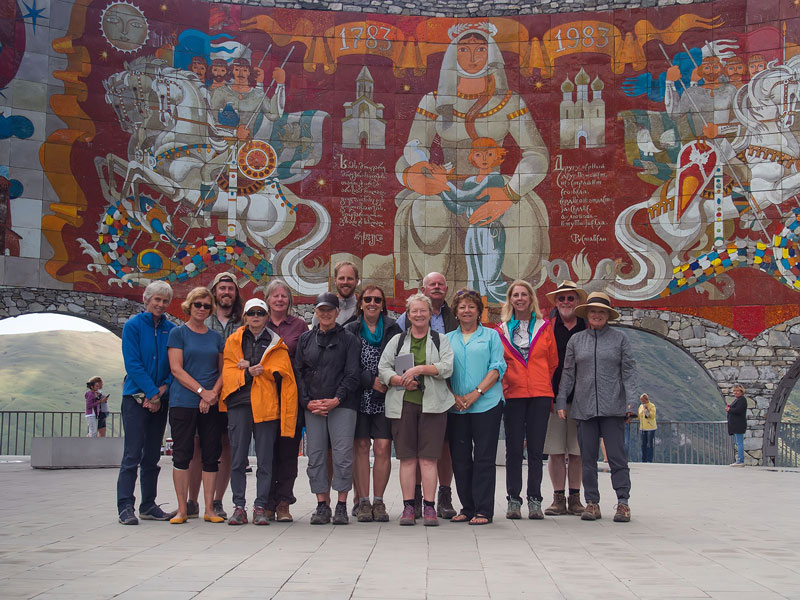 Joan S. (Vancouver, CA) - Walking in the Caucasus tour
Tripadvisor: Walking in the Caucasus with John Graham - a MUST!
Personable, beyond knowledgeable, and talented John Graham takes such good care of his guests - from first class accommodation and meals to buying lozenges for sore throat and serving champagne in real glass flutes at picnic lunches... In our "Walking in the Caucasus" tour, he facilitated an amazing experience of unforgettable places and people. His encyclopedic knowledge of Georgian history - both religious and political, culture, music, and language (he is English-speaking by birth) makes his tours unique, meaningful and extremely educational. Sing Georgian chants with him in medieval monasteries, toast with him at supras, and walk hiking paths surrounded by mountain splendour: John aims to show his guests only the splendid, unusual and remarkable. Don't like travelling in groups? No worries - the personal way John approaches his guests helps to make a collection of individuals into a group. If you really love to travel, you must see Georgia and you must see it with John Graham!
Barbara G. (San Francisco, CA) - Walking in the Caucasus tour
I believe we all felt that we experienced an extraordinary adventure that we may not easily (or ever) replicate. We had the advantage of such a lovely group of people but the trip was defined by your amazing attention to detail. As for the hikes, I thought the mix was absolutely perfect. As you know, I had a knee problem so I’m not a good judge of “challenging” right now but I think all of our group were happy with the diversity and challenge of the hikes. That said, I spoke with Nancy (who fleetingly was part of our group but is today winging her way to Bali which is what made timing pretty difficult for our trip) and she wondered whether her Sun Valley group would be good with the hiking profile. They’re a pretty aggressively fit group so they may want some more challenging hikes but I told Nancy that you would be the perfect person to make those adjustments. Bottom line? It was amazing. I would do it again in a heartbeat. Hope you’re enjoying some special time with your lovely family. We’ll be back!!
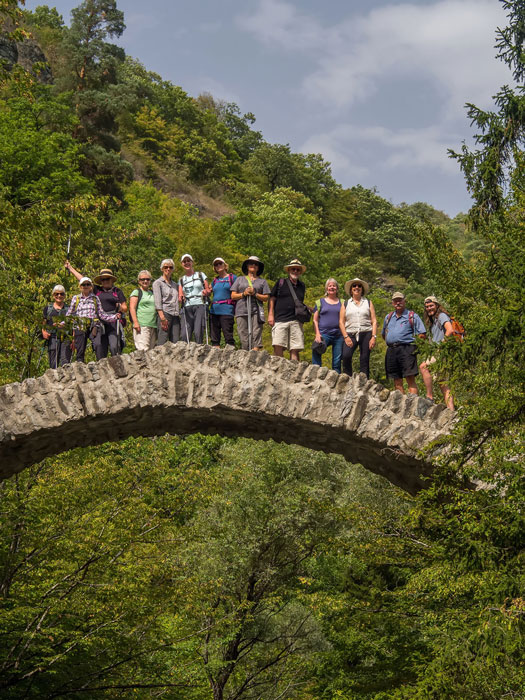 Elizabeth A. (Brisbane, Australia) - Walking in the Caucasus tour
We are still reflecting on both the wonderful time we had and the great people we met on your tour. It must have made a big impression as Phil and I have both dreamt about being on tour even though we are now in Turkey! I loved all of the hikes. I prefer walking in forests so I guess my favourite was the Mazeri hike. I think a few more picnic options at lunchtime would have been good, similar to the Rkoni day, rather than sit-down lunches. I have already told lots of my friends about the tour and will put comment online. Looking forward to club membership!
Rebecca R. (San Bernadino, CA) - Walking in the Caucasus tour
Hi JOHN, Paul and Dato... (Sounds like a rock group?) Thanks to all of you for making my birthday trip so unforgettable. It was one of the best trips I’ve been on, certainly the most informative and unusual of trips ever. It was such a treat to be able to combine incredible hiking and scenery along with amazing architecture, art, and music and visiting homes and meeting such warm and generous people along the way. I still can’t get over hiking up to tiny 7th-12th century churches and seeing all the lovely frescoes and nobody else there except us! And they were everywhere! We had no idea what was in store for us! One of the things that impressed all of us was how knowledgeable you guys are. Our car would ask poor Paul a million questions and he would know the answer to almost all of them. You guys make a great trio. And Paul...we googled the Transcaucasian Trail and found you on your Library of Congress Talk. Bravo! Again, thanks so much for a trip of a lifetime. Anything to change might be half a day off with nothing planned so we could just wonder around town. Every time we would think about taking time off, you would mention something we couldn’t miss, so off we’d go! As for the final hike of trip...what a magical ending of the adventure hearing John and Dato sing at the christening. Hope to catch up with you again, and best of everything you guys do in your future (Have raved about you to my travel agent and will be sending him photos).
Robyn E. (Brisbane, Australia) - Walking in the Caucasus tour
Tripadvisor: Walking in West Georgia
I recently spent two weeks hiking in the Svaneti and Kazbegi regions of Georgia, as part of a 12 person tour led by John and two other guides, Paul and Dato. This tour exceeded my expectations in every respect. As with all small group tours, the quality of the guides is what makes or breaks a tour. I have been on other group tours with excellent guides, but what distinguishes John's tours from others is that John does more than just lead the tour. He is master planner and organiser, hiker, singer, translator, driver and font of knowledge about all things Georgian. This is all accomplished in a relaxed and calm way, so that guests feel comfortable and at ease at all times. John's superb organisational skills mean that there are many personalised touches. I particularly enjoyed the impromptu singing performances by Dato and John, the wonderful sense of camaraderie which developed in our group from day 1, and the sumptuous feasts which we enjoyed every evening. And of course the hikes which were truly beautiful, the scenery stunning. Would I do this tour again? You bet!
Jane W. (Boston, MA) - Walking in the Caucasus tour
Dear John, that was a brilliant introduction to Georgia. I never did any souvenir shopping, but I feel like I came home with some kind of rich, colorful, intricate tapestry of sights and experiences which I will be admiring and deciphering for a long time to come. While well aware that you lead many tour groups, what struck me was the feeling that you had 'pushed the boat out' just for us! From the first dinner when you invited your musician friends, to the last spectacular setting on the terrace high above the city, joined by your and Dato's families. A slightly giddy sense of fun and adventure prevailed, solidly underpinned by truly impressive planning and management, responsive to the particular character of the group, I think. You must be aware that a great strength of the tour is your own unique position as an American who can communicate well with English speaking guests, but also as an 'adopted Georgian' with all the knowledge of history and culture and of course your singing background. Impromptu singing in churches never to be forgotten, but also all the comments on today's Georgia. Also, what excellent guides/drivers in the form of Dato and Paul with their diverse and interesting lives. We were so lucky in this respect. Feedback: I don't have much other group tour experience to compare; and also everything was new and I was happy to soak up anything that came my way. Hikes: I would have loved to do some longer/more ambitious ones, e.g. above Becho, but I realise not everyone was up for this, and besides, I would have been loath to miss out on any of the churches etc. The walk to Iprali culminating in lunch at the guesthouse was special; as was the last long day from Juta (great to have the opportunity for 3 of us to go higher) - in general, being able to walk to a site like Rkoni is great. Driving: on paper the long driving days looked daunting, but in fact with plenty of stops and interesting stuff (e.g. sweet bread!) along the way, it did not feel like too much. The drivers may have felt differently after the rough route from Ushguli. I thought it was well worth it to go up to Kazbegi as well as to Svaneti to experience the contrasts. Hotels: I loved being in the guesthouses and would happily have done more of that. At the same time, for us spoiled oldies, it is good to mix it up with the occasional more comfortable lodgings. The King David hotel was great for this. The Mestia hotel was probably the least appealing, but perfectly okay. I am mentioning your name all the time, and will recommend to anyone who shows interest in Georgia - for all the above reasons.
 F. W. (New York, NY) - Walking in the Caucasus tour
I was not sure I was a 'group tour' person, but this small personalized tour turned out to be the best possible way to experience the spectacular history, culture, scenery, food and wine of Georgia. John Graham, an American settled in Georgia, together with his 2 excellent assistant guides, was personable, fun, and knowledgeable about everything from ancient churches to current politics, and musical traditions. The atmosphere in the group was truly convivial. It was an adventure underpinned by excellent planning and organisation. Accommodations ranged from authentic village guesthouses to comfortable hotels, and hikes were tailored to our energy levels. I would definitely travel with John Graham Tours again.
Andy Y. (Philadelphia, PA) - Walking in the Caucasus tour
I recently took part in John's walking tour of the Svaneti and Racha regions of Georgia and would wholeheartedly recommend the experience. After being met by John and introduced to the group and our first taste of Georgian cuisine, the tour spent the next day near Tbilisi, climbing to some fascinating caves inhabited by monks over several centuries and with remarkable surviving frescoes. We continued over the next few days traveling to Kutaisi and then on to the Svaneti region, by which stage the scenery was breathtaking with spectacular mountains and gorge, waterfalls and Alpine meadows. On over the following days via a high mountain pass and into Racha, with a very different hill landscape at first, but then back into mountains again for more hikes and views that I'll always remember and then finally back by road to Tbilisi. The hiking was at a moderate level, with some steep climbs, but John and his other guide, Dato, consciously adjusted the routes to match the party's capability. That level of attention was apparent throughout and we were exceptionally well cared-for throughout. We stayed in a mix of hotels and local guesthouses for some nights. The guesthouses were, in some cases, fairly simple, but very welcoming and never short of food! John continually provided a mix of interesting things to see, including very ancient churches with frescoes in some unexpected places. Fighting through a field of cowpats and stinging nettles in an extremely remote village to reach a tiny church with one of the earliest known mural images of the story of St George and the Dragon (11c) was not atypical! I would say that the unexpected sights and experiences on the tour really added to the enjoyment. Meeting a still-true-believing Stalin-worshipper running a tiny museum honouring the site of a Bolshevik-era, hidden printing press was a unique (that's a euphemism for just bonkers) experience, made even more so by the fact that the only other visitors were three generations of female Chinese, on their first day in the country, who were clearly baffled by the whole thing. The surprise (to the host) advent at one of the guesthouses of some kind of 20-strong Russian improvisational dance study group, with tiny children and a dog in tow, was an equally odd thing ! Add to that an unplanned tour of a hydro-electric power plant, originally ordered in the late 40's by Stalin (there he is again), hearing highly complex classical piano music being played from a house way out in a village with the shirtless older generation sitting in a deckchair in the garden in front and seeing the start of a festival day at a hilltop church, with three lambs being paraded three times around the church and you start to get the picture of every day bringing something unusual and memorable. We were a small group, but never felt that detracted from the professionalism and care shown by John and Dato. Both guides were impressively knowledgeable and always keen to share that knowledge. Again, I would thoroughly recommend this tour.
Michelle R. (Paris, France) - Private Group cultural travel
John, I would like to thank you for having made our tour of Georgia so interesting and pleasant. I knew from the start I would be pleased to visit Georgia again and already expected finding many changes from the 90s. This was no surprise but you have made this trip particularly interesting and pleasant showing places I had not been to and sharing with us your knowledge of the history, culture and music of this country. This was something quite special. Feliciano and I enjoyed the trip very much. I know that our friends, Wafik and Gia, also did and I am sure that the rest of the World Bank group also did.
 Cathy K. (Edmonton, CA) - Private Group Pilgrimage tour (Fr. Ilya)
Tripadvisor: Orthodox Christain Pilgrimage To Georgia and So Much More!
John Graham Tours went beyond my expectations and is a MUST when planning to explore Georgia and the gems she holds within in her treasure trove!! John was a fabulous host with attention to detail to his large group of just over 30 "guests". Born and raised in America, John's love for his new home in Georgia and her beauty within it is apparent. He's a master in Georgian history and its current state of affairs, enlightening us as we travelled the country. We enjoyed scrumptious traditional Georgian cuisine and the most delicious wines I have every tasted! As a faith based tour we marvelled at the ancient sites of the churches, monasteries and fortresses. We were further elevated spiritually by the singing of John and his two companion tour guides, Giorgi and Tornike. The trio, all skilled and trained musically, sang in the traditional Georgian chant at each site that brought our visits to life. We were also privileged to have our hearts warmed by their singing while we dined at lunch and supper. On multiple occasions OTHER TOURING GROUPS, as well as local Georgians would leave their tables and gather around ours to take pictures or videos. Yes, they were that GOOD!!! We visited museums, UNESCO sites, trekked through Vardzia Cave Complex above ground, Prometheus Caves below ground, a jeep ride or optional hike up to a monastery on a mountain top, we attended a comedic play about the traditional life of Georgian families, and so much more. John was attentive and quick to respond to the needs and special requests of his "guests". Giorgi and Tornike were also attentive and always ready to lend a helping hand. These two gentlemen treated us to soft singing accompanied by the playing of a unique string instrument on the longer bus rides. I'll conclude by saying, I'LL BE BACK GEORGIA !!
Bill D. (Cincinnati, OH) - Private Group Pilgrimage tour (Fr. Ilya)
John, Donna and I thought you provided a wonderful trip experience. Your depth of knowledge and enthusiasm were top shelf. Your choice of hotels was great and the meals were over the bar...especially when you had to start ordering special meals for half of us when we were ill. Couple that with the fact that we could actually understand what you were trying to explain to us, and teaching music on top of that. Having a trained choir along for daily musical performances was a pleasant addition. I really enjoyed the "spring time" song. I particularly admired your patience to answer the same questions repeatedly. That is one trait that I do not possess. I truly believe that some people really deserve to be slapped, some more than once. Your overwhelming kindness was on display when you stopped to buy out the pharmacy for the bus. In summary, we had a great time and the trip completely met our expectations.
Ludmila D. (Russia) - Private Group Pilgrimage tour (Fr. Ilya)
The trip to Georgia was a total failure because of organizer and guide John Graham. This trip was presented as a Pilgrimage to us. People, in fact Christians of the same religion, came to visit and venerate early Christian sites, pray and have peace in our souls and minds. But instead it was very disappointing, tainted with a Russophobic attitude and comments from our guide to four of us, Russian people of this group, who came from Australia and USA. There were constant disrespectful willful insults, not even pretending to have an Orthodox spirit nor any attempts at political correctness. The historical facts were twisted and ignored. Russian people were blamed for all, people like to put blame on someone else, but well known fact, that historically in this Caucasian region with wars, tribal violence and vendettas without the “bad Russians” we would of been visiting a territory of Turkey right now! Between visits of the churches and monasteries all driving time was spent on emphasis of negativity, even the newly built church (in Kazbegi) was presented as a “political statement” against Russians. When we visited the State Art museum, we were rushed to the room of Soviet occupation? What for? And who was Stalin, Beria and their comrades? They were not Russian they were Georgian, isn’t it so? Just out of curiosity, who is to blame now, where there are no Russians anymore in Georgia, for the unsanitary conditions of the restaurants ( the whole group got sick) and the filthy toilets, unacceptable sidewalks, littered front and back yards of their own fallen apart houses, which are not even in livable conditions even on the lowest human standards?!
Never had such a negative experience, it was not worth it. Waist of time and money. There are two ways, two attitudes: either not present such a trip as a pilgrimage, because you can not hold yourself from offensive comments towards people who didn’t do anything to you or to Georgia, and considered yourself a Christian, or upfront honestly say that trip is not for Russians! This way we are not paying for own self offense! Four of us felt this way! To me you are doing this business to make money and for self glory and self promotion - but have a respect for your customers!
 Alexander P. (Russia) - Private Group Pilgrimage tour (Fr. Ilya)
Dear John, your tour was technically well organized, no delays, and physical help was provided for those who needed it. I like the musical Welcome to Georgia.... I have seen on this tour an examples of early Christianity, plenty objects of modern art and architecture created by talented Georgians over centuries. Georgian singing was very easy on ears and pleasant. The Georgian food was tasteful. In overall I have experienced what I did expect. I met a lot of hospitable, helpful and friendly Georgians willing to show local attractions. The Russian language was not an obstacle. What I did not expect: Russo phobia! On this tour were present some Orthodox pilgrims of Russian descent , I am sure they took note of anti Russian sentiments. I believe that in current fashionable Russo phobic environment in Georgia is difficult for a tour leader be level headed. Words like Russian aggression, Soviet occupation etc. are not relevant to Christian pilgrimage. Despite anti Russian attitude I still believe that Russia /Soviet Union contribution into Georgian infrastructure can not be overlooked and forgotten. I was not aware what Lyudmila will write to you. Tatiana, Lyudmila myself and others were not impressed with negative, anti Russian comments, but I was surprised with her very direct response to you. I don't want to elaborate further, as her message covers most of negative points. As a suggestion for future Pilgrimages please be objective and please, please refrain from anti Russian comments as this does not add value to similar tours.
Paulette H. (Edmonton, CA) - Private Group Pilgrimage tour (Fr. Ilya)
Tripadvisor: All Things Georgian -- On a scale of 5, this tour guide deserves 10 or even 16!
I have traveled the world a fair bit and have had some very good experiences with local guides, but John Graham has surpassed all of them by leaps and bounds in a myriad of aspects. Language is one of the first challenges with many local guides, sometimes struggling with vocabulary or heavy accents. John, who was born and raised in the US, speaks at length on any topic and is able to convey his wealth of knowledge clearly. But, the added bonus is that he has lived in Georgia for many years, is married to a Georgian lady, and speaks Georgian fluently. And that means he is able to provide extra help in any situation (even ordering extra medications at a local pharmacy) and knows the ins and outs of any situation. John is a master planner. The tour we were one was a 12-day Orthodox Christian Pilgrimage (though we did learn that he has various other tour options). As an active member of the Georgian Orthodox Church, he was able to share the spiritual treasures of the country as an insider, not an observer, but as one of our community of believers. Yet his plans also included various cultural highlights that reflected his genuine love of his adopted country. As an added bonus to the church tours, John was able to provide our group with an amazing repertoire of Georgian music. A musicologist (with a PhD from Princeton), John has a deep love for Georgian chant and brought along with us two fellow chanters from his own church. The three of them provided us with soul-stirring music in the various churches and cathedrals and enlivened our meal times with local folk songs. Wherever we happened to be, other tourists would stop their tours or stop talking at the restaurants and slide on over to our area and begin recording. We all felt so privileged to have John, Tornike, and Giorgi with us. With his encyclopedic knowledge of virtually every aspect of Georgian life or history, and with his familiarity and love for the countryside, John was able to talk at length on any topic and make the longer bus rides seem quite short. Yet he was able to convey his knowledge in a way that was interesting, but not bursting with any self-inflating pride. In fact, he has a rather humble way about him and takes care to meet the needs and interests of his audience, not simply show off his wealth of knowledge. John's caring nature is readily apparent from the onset. He is a very pleasant, genial host who treats every visitor with genuine respect and concern. With his winning smile and gentle nature, I think each individual felt that John was looking out for their own personal interests. He was never too busy to help someone who needed further explanation, to assist people who needed extra medical attention, or even to accommodate those with extra physical challenges. ( My sister cracked her ankle just before arriving and had crutches and a cast on her leg, but we never once felt we were a burden.) Unexpected challenges appeared among our group, but John was unflappable and handled things in a professional, efficient, yet personable manner. With most travel tours, one can often think of something that could have been handled differently or improved upon. Not so with John Graham. I highly recommend his tours as being worth every penny. (Maybe there will be a statue of him in the town square one day as being the one who brought the love of Georgia and Georgian music to the world. 🙂 )
 Mark T. (Texas, USA) - Private Group Pilgrimage tour (Fr. Ilya)
Tripadvisor: The search for an English-speaking tour guide for Georgia stops here.
I just finished a 12-day Orthodox Christian Pilgrimage to Georgia led by John (about 30 people), along with two Orthodox priests. I have toured over 90 countries, and I can tell you that guides don't get any better than John, at least in my experience. He surpassed my expectations, which were high to begin with, because I was familiar with Georgia. John is an American musicologist (PhD Princeton) who has lived in Georgia for many years, speaks Georgian fluently, is married to a Georgian wife, and an active member of the Georgian Orthodox Church. He has committed his life to Christ and to sharing with others the spiritual and cultural treasures of Georgia, especially its unique musical tradition. In every church and cathedral, John and two other expert Georgian singers filled our souls with Georgian three-part Orthodox chant. It made these ancient sites come alive. Likewise they regaled us with hearty Georgian folk songs at lunches and dinners, done Georgian-style with lots of toasts. John is a walking encyclopedia on all things Georgian, including its history, but he knows when enough is enough. His concern is to make his talks interesting and helpful to his specific audience, not to show off his erudition. In rare cases when he is stumped by a question, he has the humility to say so. When it comes to the practical logistics of touring, John proves himself the master once again. Well-prepared, yes. Able to deal with special needs and unplanned difficulties, yes. Unflappable. Disciplined, yes. Uptight, no. A gentle touch and a winning smile. No scolding. Real leadership you want to follow. Worth every penny. Whether you are a Christian or a music lover or not, you won't be disappointed with a John Graham tour, nor with Georgia.
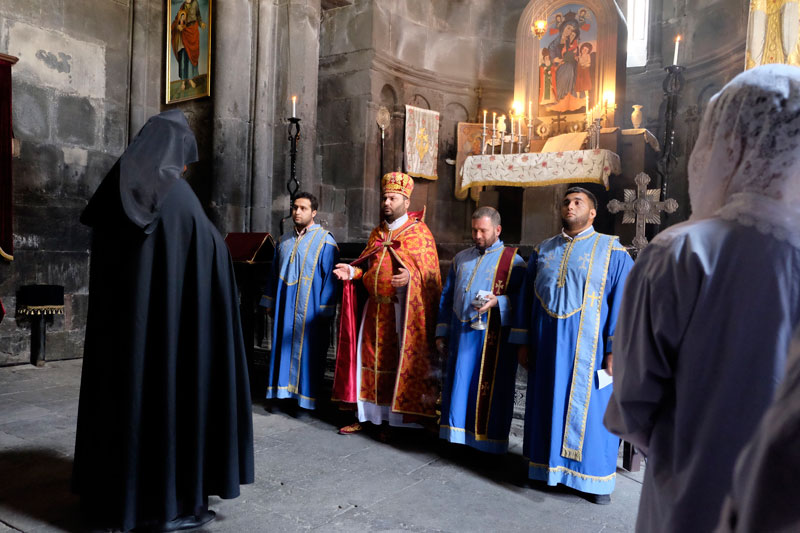 Marilee W. (Durango, CO) - Ancient Christianity tour
Tripadvisor: History and architecture in the Caucasus
Having just returned from a tour of the Mt. Kazbegi area as well as tracing ancient Christianity in the Caucasus, I highly recommend this trip. Not only churches and monasteries but also perspectives of the highly complex political history of this part of the world are provided by John Graham.
In addition winery visits, museums and of course, chanting as conducted throughout the visit make this an unforgettable experience. For me as an art historian this area offers so much that deserves more attention in college courses and media coverage.
Melissa A. (Eugene, OR) - Ancient Christianity tour
I want to thank you again for most memorable and rewarding trip to Georgia and Armenia. The trip was extraordinary. It is incredibly rare to have the opportunity to tour ancient Christian monasteries and churches in the Caucasus, even rarer to experience polyphonic chant and folk singing along the way, and rarer still to share the journey with fascinating company over exquisite farm-to-table cuisine and estate wines. Your itinerary told the story of Christianity as it experimented, developed, defended itself, and adorned itself within frescoed walls, commanding spires, and fields of grapevines and beehives. Nowhere else can tell the same story, and it took a sojourn to begin to learn the whole saga. So, it is such a beautiful thing that you invite others to share these journeys with you. You were such a gracious and thoughtful host. All of your arrangements, from the ice cream stops on hot afternoons to the tickets to evening shows, allowed us to spend our time absorbing as much of this remarkable world as we could without dealing with the usual details and demands of travel. Every day was enlightening in a new way as we learned the history of the Caucasus through its cuisines, architecture, landscape, and ancient technicolor manuscripts. The same is true for our additional private tour of Racha and Svaneti. You gave us the perfect plan, and Dato escorted us from medieval villages to glaciers to alpine meadows, filling our days with one marvel after the other. He anticipated any needs before we did and kept us safe on the most improbable of mountain roads. We saw some of the most breathtaking views imaginable and understood what the landscape meant to the storied people who fought for it. Dato showed us extraordinary churches and let us know how they express the sensibilities of the Svans, and he introduced us to the last Jewish man in Oni, who allowed us to look into the grand synagogue that waits for the return of its people. With every vista along the ridge separating Georgia from Russia, we could see why the Svans have protected their land so fiercely. There is nowhere like it in the world. Thank you again for making this all possible. You have enriched our worlds immensely!
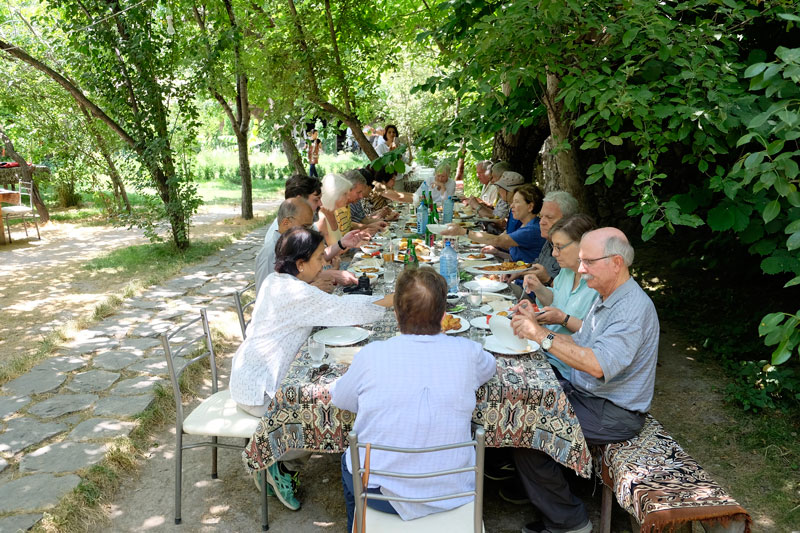 John W. (Doylestown, PA) - Ancient Christianity tour
I just returned from a two-week tour of Georgia and Armenia that was fabulous. Led by an American with a PhD from Princeton, it is a wonderful introduction to a beautiful region filled with incredible beauty and determined people who value family and faith. If you want an amazing experience that will inspire your mind and heart check out John Graham Tours. You will not be disappointed!
Ken M. (North Carolina, USA) - Ancient Christianity tour
I just returned from "Ancient Christianity in the Caucasus" tour led by John Graham; a thoroughly enjoyable and highly informative experience. There are many superlatives: breathtaking mountain scenery, ancient churches often adorned with frescoes, fascinating museums, delicious local cuisine in abundance and variety, modern and comfortable lodging, inspired singing by John and his friends, and insightful commentary along the way. Though the group numbered about 20, John was attentive and caring toward each of his "guests," as he called us. I was very thankful for the help he provided when I took an overnight trip after the formal tour ended. John really goes the extra mile to provide the best experience possible.
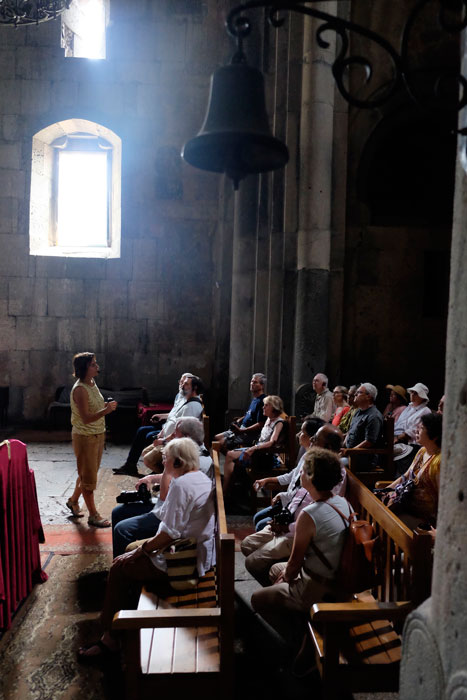 Michael G. (Serbian, living in Australia) - Ancient Christianity tour
Well, I thought I knew what was I supposed to see and experience in Georgia and Armenia: many churches, monasteries, museums, ancient sites, interesting landscapes, Mount Ararat, old frescoes, ancient manuscripts, the best stone-carved crosses you could find anywhere in the world... all of it was there, plus daily surprises and injections of unexpected beauty, seductive Georgian chanting and Armenian singing, long festive spreads awaiting for us peckish pilgrims, always in agreeable, sometimes spectacular, settings... The tour was run masterfully by John Graham who combined his insider’s knowledge of the area, especially Georgia, with his openness, pleasantness and endless patience. He is also one of the rare tour leaders who thoroughly grasped the importance of ice cream and its magical, restorative powers which removes tiredness and grumpiness, replacing them with joy and an unbearable lightness of being. Our serotonin levels were kept high at all times. The biggest stress was a decision whether to have a coffee or an ice cream after the meal, or both. Michael's further reflections on art #1 and #2.
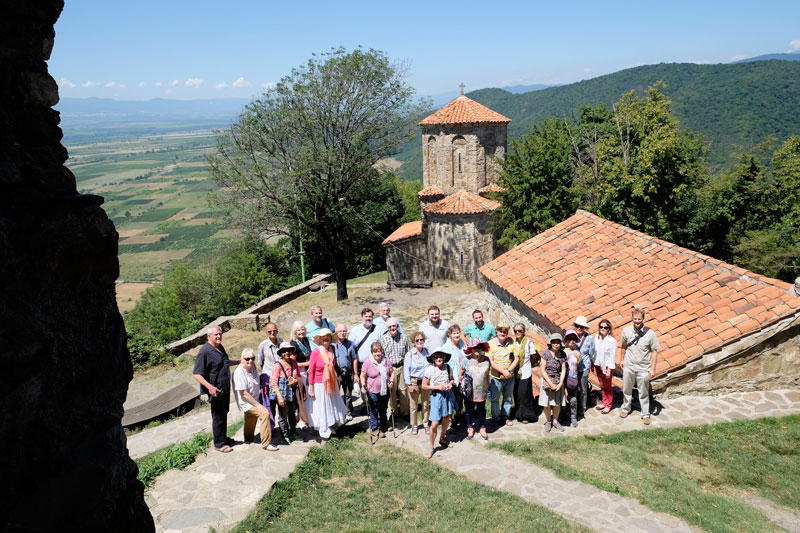 Jayashree R. (New Orleans, LA) - Ancient Christianity tour - Cathedrals of Tao tour
This June we travelled to Georgia, parts of Turkey, and Armenia on two consecutive itineraries offered by John Graham who owns the company John Graham Tours. The titles of the itineraries were “Cathedrals of Tao” (Georgia and Turkey) and “Ancient Christianity in the Caucasus” (Georgia and Armenia). To say that we loved our experience is an understatement. The reasons are many: First and foremost is John. He is the owner of the tour company, a scholar in all things about the region; he is an expert guide, a connoisseur of fine food and wine, having conducted tours in the Caucasus for over 15 years. He has built a group of dedicated people who love what they do. Their knowledge, skills, enthusiasm and a genuine interest in each of the travelers brings out the best in the group and makes for a memorable experience. John seems to attract people with special qualities to join his travels. We found most of them to be curious, energetic and genuinely wonderful human beings. Even those with rough edges were transformed and they brought a degree of camaraderie that is unusual to group travels. Our first group had 11 people, and the second had 18. We started out as strangers and have now become friends for life. John seems to have that ability and he is aided by Dato, the driver, Niko the expert guide in Turkey, and Roseanna - the wonderful guide in Armenia. What is not an understatement is that the month we traveled in the Caucasus with John and his team is the best travel experience of our lives. We plan to visit Georgia again, on a different itinerary, with the same people from the June travels. As you know we have traveled (multiple itineraries) with some of the leading companies (GeoEx, National Geographic Expeditions, Smithsonian Journeys, Wilderness Travels, Thomson Safaris, Myths and Mountains and others), and we will do more travels with each again. But the travel experience that John and his team offers is our favorite. PS: Did we mention John has a Ph.D in Musicology from Princeton? He does. He conducts cultural exchange tours all over the world (was invited to the Sacred Music Festival in Goa in 2018 with a Georgian choir, and is bringing a different Georgian choir to perform at the University of Notre Dame in 2019).
 Jayaraman R. (New Orleans, LA) - Ancient Christianity tour - Cathedrals of Tao tour
While Jayashree gave you all the reasons why traveling with John was a wonderful experience, I want to tell you why you should take this trip to Georgia and Armenia. Georgia, Armenia and adjacent countries in the Mt. Caucasus region are ancient countries of great historical and anthropological importance. Even prior to the migration of modern day Homo-sapiens into Mt. Caucasus region the Homo species of Homo Ergaster and Homo erectus were there. In the small village of Dmanisi, barely 50 miles from Tbilisi, an archeological site of great importance, 2 million year old skulls and bones of Homo erectus were discovered. Armenia, the next-door neighbor of Georgia (a country that you will travel with John) is the country where the different modern-day Indo European languages, including many Indian languages, got a start. The major attractions in Georgia are some of the earliest churches of Orthodox Christianity. The kingdom of Tao in eastern Turkey (which used to be part of Georgia and Armenia), Armenia and Georgia have some of the oldest Cathedrals of Orthodox Christianity (300-700 AD). These cathedrals have remnants of exquisite frescoes of “the Mother and Son”, the apostles and the Kings and his family members who supported the Church. It is a magnanimous sight to see Mt. Ararat, where Noah lived for a long time, and where Noah’s Arc is thought to be present even today. In fact the Armenians and some Georgians believe that they are Noah’s descendants.
One comment about the food in Georgia. If you are a vegetarian, the Georgian food has the right menu for you. I lived on their soups and salads and other vegetarian dishes throughout the entire four weeks we were in Georgia. Georgian wines are becoming very popular all over the world. Jayashree and I have been to 60+ countries. In fact when I see patients in the clinic, the first question the patients ask is “Doc! where did you go this time” and end the clinic visit with the question “When and where is the next trip”. The trip to Georgia and Armenia was very unique and being led by a leader like John is rare and wonderful experience. I highly recommend you to consider taking this journey with John. You will be thinking about the trip for the rest of your life.
Barry C. - Private cultural tour
I'm happy to comment on our trip through Kakheti with your driver-guide Dato. We have nothing but very positive comments about his professionalism, his enthusiasm and pride for being a Georgian and his dedication to making sure our trip was perfect. And, besides, he is a very nice guy. Dato is very knowledgeable about the history and culture of Georgia. We learned a lot from him and I would have no reservations in recommending him to others.
Emily S. (U. of Notre Dame, IN) - Private cultural tour
John is the perfect tour guide. He seems to know everything there is to know about Georgia, plus he has the advantage of being an English speaker and American citizen. I would highly recommend his tours to anyone looking for an authentic, safe cultural immersion!
Brian M. (USA) - Private cultural tour
Was part of a recent John Graham tour in eastern Georgia valley, including Ikalto and Kvareli areas. I highly recommend his tours - John and his team of Georgian chanters are superb singers and very knowledgeable on the history of the region. Our tour also included a traditional Georgian supra (feast) where John was a fantastic tamada (Georgian toastmaster) regaling the diners with amazing stories and legends during each of the ten times we toasted. He exemplified the best toastmaster skills - eloquent, intelligent, smart, sharp−witted and quick−thinking, with a good sense of humor.
 Ninette P. (London, UK) - Cathedrals of Tao tour
We just finished a 12 days tour organised by John Graham to visit the Cathedrals of Tao. This was a tailor made tour, full of delightful surprises and extremely well run, with the help of a handful of carefully chosen people (including singers) who brought their own charm and interests to the enterprise especially Niko. In this particular tour we also learnt and sung Georgian chants. It is indeed a privilege to be guided by a person who is deeply knowledgeable and passionate in this particular field. It was an unforgettable experience.
Anna Maria B. (Professor of Music, UCDavis, CA) - Cathedrals of Tao tour
We went with a group of seven friends on John Graham's tour "The Cathedrals of Tao." It was one of the best vacations we have ever had. The nature is unlike anything we have ever seen, the music was a revelation, and we really got to meet the singers. By the end of the tour we were also singing, and it was such fun. John was an outstanding tour guide, always providing the right kind of information, not too much, not too little. Food was excellent. And the churches, monasteries combined with the spring flowers were just unbelievably moving.
Rebecca B. (New York, NY) - Cathedrals of Tao tour
We went on the tour 'Cathedrals of Tao' with John Graham and the assorted magnificent singers and cultural advisors he brought along. The pleasures of all senses are on the tour: intellectually, John designed a tour of a past Georgian kingdom, solidly founded in Church history, but across borders (Georgia, Armenia and Turkey) and cultures, so that a muezzin is heard in the background as we visited 9th-13th century Christian churches and monasteries. John moves easily among many cultures. The singing, the frescoes and architectural detail delight the senses. We were also introduced to Georgian food and wine. Especially the latter is a revelation for anyone interested in the history of wine and the current explosion in skin contact wines and the "return to origins." We saw Georgian Kvevri (or Qvevri amphors) in caves that are imitated now in California and Oregon. In short, this was a trip of a lifetime. John and Niko, this trip remains with me in so many ways.
Patricia A. (Manila, Philippines) - Silk Road Artisans of Georgia tour
I don’t know how to begin to tell you how much I enjoyed our tour and how much more special it was because of your generous spirit. You shared so much of your knowledge and of yourself. I was telling Gina and Bettina that the flow of the tour was like Georgian chanting. It was based on drone polyphony, structured in its schedule and then again making room for improvisation, a beautiful composition. Each day built up to the next until Georgian culture surfaced gently and more clearly. I loved our interaction with the various communities you introduced us to, the chanters, the dancers, the carpet makers, the felt maker, the wine maker, the eco-tour promoter, the potter, the swordsman, all the creative people. I loved our group of seven: you of course, and Dato, who shared with us and was so much a part of our community. It brought to mind how many are called but few are chosen!!! I’m so impressed, even moved, by the capacity of each one to draw from their memories and their passion what it takes to bring out the best of their culture, regardless of the interruptions that have occurred during times of repression. It reminds me of the return and revival of indigenous species of trees which no matter how much they were trampled dug deep in the earth until one day, when the land was eventually abandoned, they sprouted from the earth to rise into what’s becoming a new forest. I am inspired to give a talk to our students on the revival of the traditional arts based on my experience in Georgia. It is indeed a good illustration of the revival of the traditional arts, where continuity is interrupted by circumstances. It was fitting that our final day was Georgian Independence Day. We caught a glimpse of the parade when we went for lunch at Mado and felt a sense of celebration.
Susan S. (retired judge, NY USA) - Silk Road Artisans of Georgia tour
John Graham, a U.S. citizen, who has lived in Georgia for several years, gave our group the opportunity to see many facets of life in this eastern European nation. He has developed many friendships and we were the beneficiaries, as members of his "Arts and Artisans" tour this May. We visited people’s homes, a school for making icons, a school for making felt and felt products, a village where the women are weaving rugs in the traditional way. John has a doctorate in musicology and the subject of his dissertation, Georgian Liturgical Music, made our trip very special. The music is quite different than western church music as we learned when his friends sang for us in churches and also sang in restaurants. We were able to attend a wonderful, actually amazing, rehearsal of a dance performance. John filled our days with many activities; there was no time to be bored, although there were opportunities to opt out of the offerings. Incidentally, the price was all inclusive- the only extras we incurred were for items that we decided to purchase.
2017:
Celestine B. (Paris, France) - Cathedrals of Tao tour
The idea was to take a trip with my 22-year-old daughter, Liza, an adventure worthy of a college graduation present. We settled on a 10-day journey through the small Caucasus country of Georgia, with a swing through neighboring Turkey, in search of the long-lost kingdom of Tao....These remnants of ancient Georgian culture were what drew us to join John Graham, an American musicologist and tour leader who lives in Tbilisi, the Georgian capital, and seven other travelers on a journey that began in the Black Sea city of Batumi, circling through the Turkish cities of Kars, Yusufeli and Ardanuc, before ending in Tbilisi.
John himself, whom I had met in Paris when he was touring with a choir of Georgian singers, provided the other lure. An academic expert in Georgian polyphonic chant, with a doctorate from Princeton, he had promised us music along the trip, and he delivered — including in a Georgian restaurant and a Turkish tearoom, isolated mountain churches and a rousing summer jazz concert in a Tbilisi park. Read the full article in the New York Times.
Olga H. (Professor of Lit., Princeton NJ) - Colchis & Svaneti cultural tour
John Graham’s deep understanding of Georgian culture, history, geography, and politics combines with his thorough familiarity with life in Georgia today. Add to this a keen sensitivity to those around him, a warm disposition, and superb musicianship, and you have a truly exceptional tour leader who will help you not just learn about this ancient land and its people, but to experience it deeply. Dizzying views, snowy mountains, reverent frescoes in 5th century churches, a home where the lady of the house teaches everyone to make mouth-watering Georgian dumplings (ravioli meets origami), and generous hospitality and music everywhere. John’s experience and spirit shine as he graciously attends to everyone’s interests and needs. Three guides with delightful temperaments and exceptional musical abilities for nine travelers is hard to beat. No rigidity here! The tours flow. They have enough structure to preclude chaos but also enough flexibility to take advantage of opportunities that present themselves and to respond to interests of individual participants. There is no other country like Georgia and no other tour group like John Graham’s.
Jan Matushka K. (Delaware, USA) - Private Group Pilgrimage tour
In May, 2017 I took two private tours with John. We had a full day as he drove up into the mountains to Sachkhere and Chiatura. Sachkhere is especially beautiful. Went visited both churches and important house-museums, as well as enjoyed a delicious lunch in a spectacular location along a stream in Sachkhere. I also enjoyed a one half day to sites off-the-beaten path in the Mtskheta area, visiting both a Syrian Orthodox men's monastery (where Aramaic -- the language Jesus spoke - is used), and a small female monastery. Enjoyed a great lunch in Mtskheta that gave us views over the city -- of Jvari Church and Monastery, Samtavro, etc. John is friendly, professional, knowledgeable and flexible. Was thrilled to see sites I'd never seen with him. I'd definitely go on a private tour with John again. Thanks, John!
Christine M. (Head of Greystone Academy, Philadelphia, PA) - Ancient Christianity tour
Our June 2017 Ancient Christianity tour through Georgia and Armenia with John Graham was a moveable feast of history, nature, music, art, food, and wine. An exceptional experience. In addition to the planned sights, John introduced us to out-of-the-way treasures and many treasured people including:
- A beautiful restaurant in Tbilisi where John and his singer friends serenaded us with traditional Georgian folk music and chant.
- A personal conversation with the priest of Kvelatsminda monastery, facilitated by John’s Georgian/English translation.
- A spontaneous road trip to see medieval ruins by half the group, while the rest of us sat on the back porch gardens of our impeccable hotel, listened to the bells from the monastery on the hill, and watched a storm come in over the mountains. Something for everyone!
- The dramatic natural beauty of both Armenia and Georgia.
- A jewel of a restaurant and organic winery tucked away in a tiny town on a rural road in Georgia, enhanced with original art, artifacts, rugs, and a gourmet chef.
- The manuscript museum in Yerevan. Wow!
- The Armenian rug company for handmade rugs where artisans let us sit beside them and try our hand at the double Armenian knot.
As tour guide, John is kind and calm, providing customized attention to each tour member. John’s knowledge of the local area, history, music, architecture, and Orthodoxy make him tour guide and teacher in one. Accommodations were boutique, beautiful, and comfortable. With all details taken care of (hotel arrangements, fees, transfers, meals, timing), it was easy to relax and just enjoy. Highly recommended.
Carrie C. and Patrick E. (VA, USA) - Private cultural tour
John's tour brought us to the perfect intersection of mind-boggling history and awe-inspiring nature. We hiked a desert mountain covered in blue and pink springtime flowers, we stood in quiet reverence of the grave of a millennia-old saint. We stood at the top of the crumbling rampart of an old fortress and contemplated the green valley below, where hundreds of years earlier the farmers of that rich land feared the ever-present threat of raiders. John's engaging commentary brought the landscape to life, and fortunately he also knew the countryside like the back of his hand, so he navigated winding, unmarked roads with ease. Often, the end destination was a delicious meal at an off-the-beaten-track restaurant. John conveyed his love for Georgia, and convinced us to fall in love as well. We can't wait to go back.
Allison and Eric J. (Atlanta, GA) - Private cultural tour
To fully experience the beauty, culture, religion and cuisine of Georgia, I highly recommend “John Graham Tours”. I was lucky to be connected to John through a mutual acquaintance, and from the moment I reached out to him, I knew we were going to experience a trip of the lifetime. John organized a private tour for my husband and me to hit the major sights of the country while staying in deluxe hotels. He helped me to identify regions of Georgia that I may have missed had I not contacted him. John personally picked us up from the airport and took us to the hotel in Tbilisi and arranged a private driver and guide, Dato, to take through the rest of our trip.
Upon meeting Dato, I knew we were going to have an amazing time. Dato is extremely knowledgeable and passionate about Georgian history and culture. He took us back in time as he told us stories of Saints, Kings, Queens and the turbulent history of Georgia’s past. I felt as though I personally knew St. Nino and upon finally reaching her burial spot at the end of the trip, felt a deep appreciation of everything she had done to shape the religion of Georgia. As an avid hiker, he also took some of the most beautiful walks I have ever experienced in my life. He introduced to the absolutely amazing Georgian cuisine helping us navigate through menus and encouraging us to try dishes we otherwise would never have known about. After our tour of Georgia, John arranged for a driver to pick us up at the Azerbaijan border to take us to Baku. Dato walked us through the checkpoint and personally made sure that our driver was there! This was so above and beyond what we expected.
My husband and I can’t thank John and Dato enough. Our trip would have not been nearly as special without them and now we don’t only have a much better appreciation of Georgia, we have two new friends! I highly recommend you go to Georgia and you plan your trip with John Graham Tours.
Jim W. (Minneapolis, MN) - Colchis & Svaneti cultural tour
I have had the good fortune of traveling all over the world with all sorts of tour groups and guides. This, by far and away, was one of the best and most memorable trips of my life. John and the group members were simply amazing! I am already thinking to myself -- how can I get back to Georgia? John thanks for guiding me on this trip! I give it five stars.
2016:
 Mark B. (Library of Congress, Washington DC) - Tusheti Highlands and Viticulture tour
It is hard for me to imagine a more pleasant and well-organized way to see Georgia than on one of John's tours. The combination of interesting sites, well-planned itineraries, great food, and capable guides is outstanding. John's relaxed style coupled with his thorough knowledge of Georgian culture and history makes every day a learning experience, and his ability to adapt and modify the itinerary when unexpected obstacles arise is not to be underestimated. I can't recommend these tours highly enough.
Amanda C.-E. (Yale University, CT) - Private Choral Group tour
John was a tremendous resource when the Yale Women's Slavic Chorus toured Georgia in 2016. He is a careful planner, deep listener, and excellent teacher, eager to share his knowledge and love of Georgia's culture, music, and landscape. When I started to plan the choir's tour, he was one of the first people I contacted, and he helped ensure our tour was successful and on budget. John's suggestions for our tour included the perfect mix of musical workshops, sightseeing, feasting, and time spent reveling in mountainous beauty of Georgia's countryside. I am forever grateful that John shared his contacts with me; he has close relationships with amazing teachers like Soso and wonderful guides like Dato, and together John and his friends ensured that our tour was not only instructive but also inspiring. John's strength is in crafting complete experiences - tours that showcase the diversity of Georgian cuisine, traditions, and geography. His passion for Georgia is infectious and his knowledge incomparable.
Tamara J. (Dean of Mercy College, New York, USA) - Colchis & Svaneti cultural tour
Well, for starters, it was a fabulous tour that surpassed my expectations. You are a wonderful leader, John, and perhaps even without realizing it, you set the tone for a relaxed, informative, and fun experience. If you were annoyed by anything, you never let it show, and kept your good humor the entire trip. If anyone had any issue or problem, you tried to correct it immediately. So, we were all in exceptionally good hands. I can't thank Shergil and Soso enough for all of their amiability and -- best of all -- their beautiful voices!!
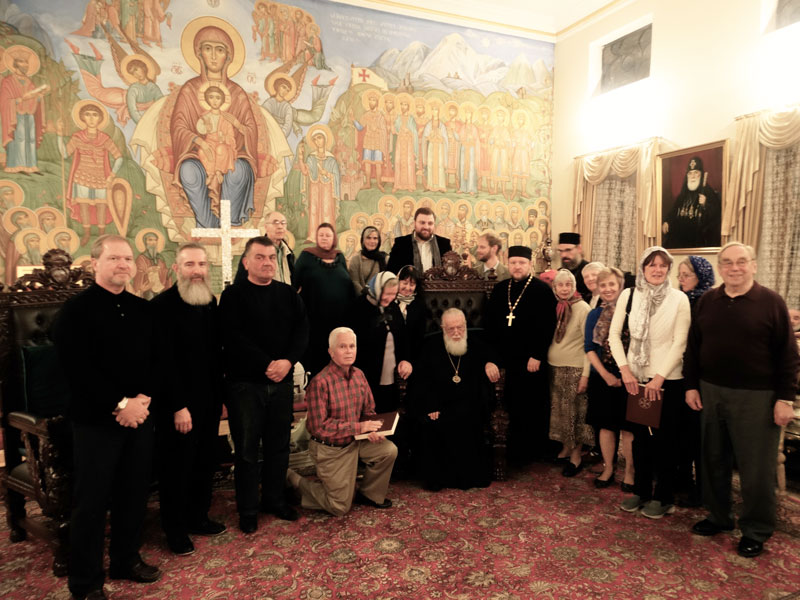 Margarite L. (Boston, MA) - Private Group Pilgrimage tour
The Pilgrimage to Georgia Tour was an absolute delight! John, Soso and Shergil were like gracious hosts and friends, making sure we had abundant, sumptuous food and drink, and plenty of spectacular landscapes to enjoy! Many of the ancient churches and monasteries were hidden jewels that would have been impossible to visit without them. Plus, their voices in all those sacred spaces were unforgettably moving. I highly recommend JohnGrahamTours, as they provide an intelligent, thoughtful, and insightful Georgian experience, in addition to warm and welcoming hospitality at every turn. You will come away loving Georgia.
Natalia M. (Falls Church, VA) - Private Group Pilgrimage tour
Dear John, Thank you again for organizing and leading one of the best tours I have ever taken. You and your two wonderful assistants, Soso and Shergil, made this tour memorable and successful. We visited so many beautiful sites, learned so much about the cultural, historic and religious aspects of Georgian history, discovered delicious Georgian cuisine and wines, and last, but certainly not least, heard and appreciated your chanting. It was an unforgettable experience! If you, Soso and Shergil are ever in the Washington DC area, please let me know and I will be happy to assist you in any way I can. I'm attaching two photos -- of you chanting in the Shuamta Monastery and singing at our farewell dinner.
Margaret H. (New York) - Private Group Pilgrimage tour
Knowing you and being with you on the Georgia tour and participating in the listening and singing of the chant, was pure delight. I also keep a fond memory of our visit with the Patriarch and the ballet. Thank you for all the extra effort you put into doing these things for us... they are appreciated!
Galina T. (Florida, USA) - Private Group Pilgrimage tour
Hello, John, I want to thank you for your very well planned and executed group trip through Georgia. We all (we talked about it!) agreed that the success of the trip, in spite of the weather, was mostly due to your wonderful management skills and your great personality. With half the people sniffing and coughing, and some, like me having other health problems, you managed to keep everybody happy. I was very happy to meet you lovely wife and we had a nice chat and found out that we both started our Romance language studies by taking Portuguese. I wish her great success in defending her dissertation, and you as well. The Georgian chants that we were treated with in almost every church, gave it an extra glorious feeling. Please give my greetings to Soso and Shergil, without whom you would probably not have been able to manage as well. They were both terrific. I want you to know that if ever you come this way (to Florida) please, come and stay with me. I will have room for your family and will provide entertainment for all. Thank you again, Love, Galina
Fr. Lawrence and Ann (Santa Rosa, CA) - Private Group Pilgrimage tour
Dear John, Thank you for the email and the links. Ann and I are well, thank God, by your prayers. Forgive me for not emailing you earlier, say back in November. I want to thank you for your kindness, for sharing your talent and love for the Georgian Church, saints and liturgical singing (you’ve become a master), and for your professionalism. Reflecting back a bit, that trip was so wonderful, and enlightening. It opened up all kinds of things for me, and I have the warmest memories of a trip, a pilgrimage, strangely, without difficulty. Usually pilgrimages have all kinds of obstacles, since that’s just part of the struggle, but YOU did all that ahead of time, and privately, sacrificing yourself for us, so our trip would be smooth. Thank you so much. With love in Christ, and wishing you a most blessed Nativity of the Lord, Fr Lawrence and Ann
2015:

Andy L., MD (New York, NY) - Colchis & Svaneti cultural tour
This was a wonderful tour with many surprises. Salient among these was the arrival in Ushguli, Svaneti, where we all were overwhelmed by the appearance of the mountain, Shkhara, looming magnificently over the town. I have rarely experienced anything like this on any trip and ranks with one of the most memorable sights I have seen (for me, ranking with Red Square and Borobodur in Java).
John is a highly knowledgeable tour leader: he can talk about Georgian architecture, art, and, of course, the music. Having two other assistant tour leaders who were able to create the three-part Georgian polyphonic chant was brilliant. Every church we entered was soon filled with the sounds of a chant (or two). The evening supra feasts were filled with song. The food at the noonday and evening meals was varied, tasty, and very interesting. There was an attempt to always provide local specialties wherever we were. For me, struggling with the sounds and phrases of the Georgian language were an added attraction. I would highly recommend this tour for anyone interested in music, culture, history, food, and language.
Marilyn B. (Art Professor, Missoula, MT) - Colchis & Svaneti cultural tour
The Road to and from Ushguli. The journey to a place, for me, can be as significant as finally arriving at a destination. Such was the road to Ushguli. Immersed in Orthodoxy on this tour, its rich regional history, its architecture and ancient chants, all the icons, the angels, saints and martyrs, it felt that day as if we were part of the story, being guided through the landscape by a couple of spirits in the guise of bus drivers, who delighted in showing us details along the way. We stopped to pick wild strawberries and to walk through mountain streams that washed away our gravel road. We found interesting stones in the stream as the drivers helped us across. At other stops we took in the expansive view around us and tried to photograph what we have no words for. Being in Ushguli, though only for a brief evening, was the highlight, but the ascent to that magical place and the gradual leaving of it is part of a fond memory. Continuing on to Racha, we stopped to look down at melting glaciers in the valleys below while our drivers picked a bouquet of wildflowers for the ladies. Arriving back on a paved road later in the day brought an abrupt end to that otherworldly mountain experience.
Sara B. (Cambridge, MA) - Colchis & Svaneti cultural tour
To encounter Georgia for the first time, and to be guided through the country by John and his remarkably talented friends, is a uniquely enriching experience and, I imagine, quite a rare opportunity. Georgia itself is nothing short of spectacular. I was continually surprised and awed by its cultural nuances and natural wonders, and these alone make a visit to Georgia memorable and even life-changing. But the credit for making this a particularly meaningful trip is due to John’s warm-spirited nature, his depth of scholarship and practice of Georgia’s ancient musical traditions, and his seemingly encyclopedic knowledge of many other subjects as well! I can easily imagine traveling in Georgia alone, with no language, no local connections or friends to host you, no idea how to best experience the remote beauty or the tiny chapels in forgotten villages, no immediate introduction to the music or the supra tradition (which both add so much to the full experience). It could be a very lonely, limited encounter with a country that has so much to offer.
John’s command of Georgian history, culture, and language is remarkable and enlivened by his apparent love for the country. Most impressive was his skill at knitting a group of foreigners into the dense tapestry of Georgian family life, sacred space, and cultural tradition with ease. He has clearly endeared himself to his Georgian friends, and their generous hospitality is extended to anyone traveling with him. I feel changed for the better by John’s tour of Georgia and would say that it provides the best of what travel has to offer to human experience: awe, adventure, history, cultural exchange, natural splendor, spiritual/personal reflection, new perspectives on living, and deep moments of community, humility, and friendship.
 Matthew A. (Music Professor, Iowa City) - Colchis & Svaneti cultural tour
I went on John Graham’s Cultural Heritage Tour through Western Georgia with the principal aim of learning more about Georgian music, particularly Georgian chant, in its own spatial, social and spiritual contexts, in order to be able to study it properly. I had high expectations for the trip, because soon-to-be Dr. Graham is the foremost researcher on Georgian chant in the English-speaking world and an experienced tour guide, and because Georgia is a beautiful and bounteous country. Even so, my expectations were but shadows of the wonders and insights that I experienced. The people are generous and spirited. The food and wine are incredibly sumptuous. The music is haunting and robust. The land is heaped with variously colored hills and mountains, not unlike the heaps of varied dishes at a Georgian feast. And I was able to pepper the captive Mr. Graham with incessant technical questions on the long car rides, thereby gaining a better picture of the music. I also acquired six recently published but rare volumes of Georgian chant scores and a rare CD of folk music and chant with traditional tuning.
The tour was enriched by the singing of our three guides, John, Shergil, and Soso who are all professional musicians. They would sing at each church or monastery that we visited, allowing us to hear the music’s proper tone and resonance. They also regularly sang table songs at dinner. Toward the end of the tour, Soso had to leave, and John and Shergil taught me a couple chants and allowed me to sing with them. This opportunity was a great honor and pleasure.
The tour was also enriched by the music of other Georgian musicians. In Batumi, I came across a quartet of folk musicians on the boardwalk. In a village in Svaneti, we had lunch with the two masters of Svanetian folk songs in that area and heard them sing. And in Tbilisi, I attended a Vespers service and heard two styles of chant from antiphonal choirs. Something I have realized from my various experiences is that Georgian music is extremely varied in style, taste, and skillfulness, and its theory and practice are contested and changing. This realization is at once humbling and inviting.
Connie T. (Princeton, NJ) - Colchis & Svaneti cultural tour
Hi Everyone! My return flights were smooth and I arrived in Princeton appropriately tired. Monday found me at my icon painting class, an annual event, working diligently on an icon of Elijah. Finished the class on Friday, but the icon remains a work in progress, and then began my "recovery" from the jet lag. I want to tell all of you that I enjoyed meeting you, and sharing the Georgian Experience! Beautiful singing at table and in the churches/monasteries will remain in my memory for all time! Good food, conversation and wine capping off each day, I can only describe as beyond any expectation. I look forward to seeing the pictures you post online, and thank you in advance for sharing them with me. Most appreciated since my hand isn't as steady while holding a camera as it used to be. Be well everyone; have fun, and laugh a lot!
2014:
 Peter T. (retired lawyer, Chicago USA) - Colchis & Svaneti cultural tour
Inter alia: I would like to commend the graciousness, hospitality and kindness of the Georgian people; the beauty of the landscape and its many ancient churches and the singing; the courteousness and lavish generosity of our host John Graham; the wonderful food and commodious accommodations during the tour; and finally, again, John was extremely knowledgeable and unstinting in sharing Georgia with all of us.
Steve G. (Boston, MA) - Colchis & Svaneti cultural tour
On our 2014 tour, I want to say that all our informal group interactions, taken together, became the main highlights for me. All the meals we shared together and the music you professional chanters sang at those meals (as well as at the monasteries and other places) were unforgettable. And again, the 1st class accommodations that you arranged were an unforgettable and unexpected delight. Thank you again for that! Another highlight was witnessing the consecration of the bishop and the beautiful music that was part of that ceremony. It was just sublime! We will never forget that. We listen to the CD of that beautiful music...that you subsequently gave us...both in Maine and at home. It creates a heavenly vibration in both places, puts us at peace and vividly reminds us of that experience.
 Michael S. (Brisbane, Australia) - Colchis & Svaneti cultural tour
What a find!! Looking for something to tack onto a trip to Armenia I chanced upon John’s Monastery Tour. It turned out to be the best decision I have ever made in regard to holiday travel. The itinerary was well thought out, the meals and wine were superb and the chanting of John, Soso and Shergil is a memory to cherish forever. Dinners were turned into feasts with their music and singing. Other highlights (realistically the entire trip was a highlight) were the visit to the Vardzia cave complex, Davit-Gareji Monastery with a climb over the hill to view the cave murals and a trip to the Gergeti Sameba Monastery in the High Caucasus. So memorable was the Monastery Tour, I joined John again in 2016 for Cathedrals of Tao itinerary. Another great experience. Thank you John for such wonderful tours.
Carol W. (Hanover, NH) - Colchis & Svaneti cultural tour
My Georgia tour with John Graham was hauntingly memorable. There were vast open spaces, cattle in the roads, rural monasteries and incredible meals shared with the entire gang and wine toasts to life, to our incredible trip and its guides. Every destination monastery was punctuated with views of towers, historic chapels, filled with frescoes of the saints, friendly monks who loved our visits and enjoyed sharing John's. Soso's and Shergil's vocalization of ancient chants that echoed throughout the historic churches. What made the trip so unique was the multi-layered culture and John's close relationship to the people, the history and heritage of Georgian regions, the locals with whom he related and the music that surrounded us throughout the trip. John is fluent in the Georgian language, culture and music. The trip was one of the best of my life and I have recommended it to others who then went on his tours. They returned to tell me their experiences were exceptional and equal to mine. I look forward to going on another trip with John and know that it will be of the highest quality possible. Hoping to go on another trip next year!!!
 Lin M. (lawyer, Dallas, TX) - Cathedral of Tao tour
The 2014 tour to Tao-Klarjeti and Svaneti, among other destinations, was one of the most remarkable experiences of my life, and my wife feels the same way. The breathtaking physical beauty of Svaneti was a revelation. Those towers in those alpine landscapes have lingered in my memory ever since, and in our dining room I’ve mounted four 30x48 inch paintings of the magical mountain village of Ushguli. Walking on dirt roads there one early morning, elegant towers against mountain backdrops in every direction, is for me a particularly treasured recollection, as is the memory of one morning in Turkey, when John Graham led us to the deserted ruins of a medieval Georgian cathedral, out in the countryside, where one felt far removed from the modern world. There is another specific memory that is really not of a particular moment, but of many moments that have fused together in memory into one. Night after night we had Georgian feasts, at which John introduced us to local toasting customs. Almost giddy with the quality of the wine and the company, we all made and heard expanded toasts, and became real friends at a surprising speed.
John Graham is the ideal guide for journeys to Georgia. He is a charismatic and extremely articulate scholar who is deeply learned about the place and its history. Long a resident, and married to a Georgian wife, he has a deep understanding of the local culture, cuisine and wine, and has perceived and perfected exactly how to impart the essence of Georgia to his fellow English speakers. If you want to see a often neglected corner of the world on a trip that is at once exciting, intensely pleasurable, and a profound learning experience, a John Graham tour is just what you need.
 Vivian P. (ceramicist, Maine) - Cathedral of Tao tour
The Tao-Klarjeti and Svaneti tour proved to be a transformative event in our lives. The sights, the sounds (absolutely nothing can compare with hearing your tour guides chant in magnificent churches or monastery ruins and break out with folk songs during fabulous Georgian dinners), and the new friends we made... it made this trip unlike any other we’ve taken before or since. As if the incredible sights in Tbilisi, Vardzia, Oshki, Ushguli, Batumi and Kutaisi weren’t enough to keep us enthralled, John Graham and his Georgian colleagues Soso and Poti gave us their attentiveness, their caring, their humor and especially their musical mastery added an element of pure magic. An added joy is that a few years later we’re still corresponding and visiting with friends we made on this tour.
2013:
 Carol W. (New Jersey, USA)
The 2013 Monastery Tour exceeded my expectations at every turn! Without doubt, it was the finest trip I've ever experienced. Georgia was an amazing cultural experience, and John Graham and his co-workers did everything imaginable to add wonderful touches to the trip. It was a spiritual, cultural, culinary, and intellectual feast, with amazing, unexpected delightful surprises at every turn.
Marian B. (New Jersey, USA)
The music and the sacred spaces: surely the most memorable and moving of all our Georgian experiences. Yours, Soso’s, and Shergil’s beautifully blended voices raised in chant in the churches and cathedrals transformed those visits into worship. Deeply moving also was the response of people who had the good fortune to be in church at the moment of your chanting.
Terry C. (Texas, USA)
I think differently now. Georgian drivers do not ignore the white lines at all. In fact, they use them for alignment: two tires on the left side of the line and two tires on the right. As oncoming traffic is doing much the same thing, driving can resemble a perpetual game of "Chicken." If you need to pass, no problem. By all means do so, whether on the right or the left. If you are going around a curve, just go for it anyway. Do not concern yourself with the oncoming traffic. They will scoot over. Or not. And so now I realize that Georgian drivers are simply the best in the world, as they maneuver around cows, pigs, switchbacks, and potholes the size of small bedrooms, all with effortless aplomb. Our driver, Achiko, proved to be the best of the best.
2012:
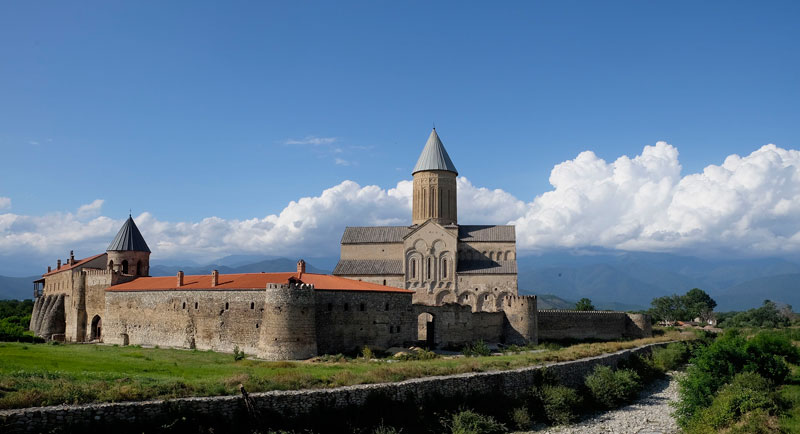 Tim T. (Washington DC)
Myself, Parker Jane, my daughter Phoebe, and Fred Binkholder from the Capitol Hill Chorale have participated in a ten-day tour with John. While there, we had a fascinating tour of the country’s geography, including a series of breathtaking sites of monasteries not easily accessible to most persons, including Georgians. Repeated highlights of this trip were our informal concerts by seven of our group, plus John and his right hand man Shergil, - that is nine persons, split into three groups and led by John in singing the unique-to-Georgia “Georgian three-part harmony chants”. Western singing is based upon the Bass voice part, with harmonies moving to the higher voices; in these Georgian chants, the upper voice sets the scale and the other voices form the harmony -- all together an unique sound.
I can think of no person more knowledgeable or more immersed in this country’s musical culture than John Graham. He has lived in Georgia for years, speaks the language fluently, married a wonderful Georgian lass with whom he has had a daughter. And he incorporated other professional singing groups with our fledgling triple-trio – it was marvelous. As a host, teacher, tour leader, and Georgian music savant, John is without peer and I cannot recommend him more highly.
Parker J. (Washington DC)
I was on John’s Georgian tour with Tim in 2012, and I had wonderful experiences on tour. As the founder of the Chorale, the musical editor responsible for resurrecting a major early twentieth-century Georgian choral work, and a co-author with John Graham on a journal article about that work, I can offer an additional perspective on the potential of an exciting partnership between John and any company.
First of all, although it is not widely known in the West, Georgia has one of the most fascinating and longest continuous choral traditions of any country, stretching back well over 1,000 years. Georgians developed true polyphonic singing hundreds of years before it appeared in Europe. To me, Georgia is one of those few special countries – along with Wales, South Africa, Bulgaria and some others – that have a special and unique tradition of choral singing that should appeal to music lovers generally, and lovers of singing especially. Georgian vocal music, though, is significantly different than Western music, including different tunings that may sound strange to western ears. Also, Georgians are used to ensembles that are much smaller than the size of most western choruses.
What I think John can uniquely offer clients instead is not only an exposure to but an immersion in Georgia’s fascinating musical traditions. As Tim described, on our tour we visited monasteries across Georgia. At each monastery and church, John prepared us to sing a piece of Georgian chant – an indescribable way of experiencing this music. For me the culmination was chanting during a Sunday service, at the request of one of the priests, in one of Georgia’s oldest and most revered churches.
A note about John. He is, simply, the preeminent expert in America on Georgian liturgical music, with years of research and performance experience in the country, and a recent doctorate in the field. He is also a superb tour organizer with almost 15 years of organizing tours for Americans and others in Georgia. He’s engaging, personable, a wonderful tour leader, and seems to know everyone in the country. If your taste doesn’t go beyond the Mozart and Brahms Requiems, this probably isn’t for you. But for musicians with curiosity for uncovering new delights, it’s hard to beat. I’m happy to talk more if you’d like, but hope this gives you enough encouragement to take a next step.
Marilyn B. (Professor, Missoula, MT)
All of Georgia in a Bowl of Wine
We arrived shortly before Vespers at the Martvili Monastery on the afternoon of June 23. The bishop was in attendance. John and Shergil sang with the men chanters, alternating with the women chanters. We stayed for part of the service and were then shown a loft room at the back of the church, now made into a small museum, where King David the Builder (12th century) would attend services and pray and study. As a child, David had been raised by the Bishop of Martvili, we learned, and had always returned for Great Lent fasts. Because John knew one or more of the monks, we were then invited to visit the Monastery's wine cellar, where wine was made according to Georgian tradition. Grapes, skins, seeds and stems are all pressed and aged in the particular Georgian vessels called qvevri, underground beeswax-lined clay vessels. Nothing is added. The grape skins themselves contain the yeast to ferment the wine. A monk poured a clay bowl of red wine for each of us. There were toasts and the singing of chants. I did not want to offend by not drinking it, as wine has always made me ill. But I took a sip. It was the color of dark red velvet. It had a rich texture. The taste was complex, earthy and mellow. It was unlike anything else called wine. I had heard stories about the meaning of wine to Georgians over their history, experienced the Supra tradition where Georgians toast to the health and long life of everyone at the table, and I grew up with Bread and Wine as the Sacrament. But I had never experienced wine as in that clay bowl.
Georgian music drew me to this country. Music and Georgian hospitality draws me back. Here I was in a Monastery cellar, with its history of prayer and endurance, its saints and martyrs. I was in a place described as “probably the most beautiful country on earth,” and I was drinking it all in, in that clay bowl of red wine. I slowly savored every drop and gave thanks for the gift of that moment.
Richard D. (Professor, Missoula, MT)
In my opinion you put together a wonderful 2012 Monastery Tour. I thoroughly enjoyed it and would do it again--provided it had more stops at wineries. 🙂 You showed us a lot of the Georgian countryside as well as giving us a good look at the people and culture. I liked that because when I go to a place I want to know about its people. Additionally, you gave us an "inside" look at the Georgian Orthodox church, which was important because from what I saw the church is like a glue that holds the country/people together. If I'm wrong about that, please tell me.
For me there were several high points on the tour. First was the chanting. It was lonely and I was moved by it. You did a great job getting the members of our group up to speed. The high point in the chanting was our experience at the church in Ubisa. When those young women surprised us with their chanting we were amazed. For awhile with the two groups we had the dueling chanters. Too bad we couldn't have traveled a little with them. There were several other small things that were high points for me; meeting the bishop at the vespers service, tasting the wine at the monastery, buying--and devouring---raspberries, the relatively long hike to the monastery, the meal with the family in the village, the toasting at meal time and many others.
Alix K. (San Francisco, CA)
I have some deeply fond memories of Georgia in my heart – especially the Orthodox moments (touring and singing in the churches, the services); a few of the special moments when our voices really seemed to meld and come together; the mountains (I wanted more of those!).
Most of all I treasure the soul and spirit of the Georgian people, their awareness of the joy and blessings touching them at each present moment, and their readiness to thank God for it and express their love for the people sharing in their joy at every given time. I learned from them the importance of solid faith and conviction in belief, of the need to be aware of every good thing and to find a way to share what is in the heart instead of taking it for granted and keeping it inside oneself. For this I am very grateful. There were several times – especially our last night together, when the locals joined us – that I felt the richness of community within the people in whose company we were lucky enough to be. I spoke to Luarsab about this, that your little group of friends seems so unusually loving and caring towards each other. And every one of the people in it seems especially talented, unique, blessed by God. Something else I felt again and again was how truly Orthodox a country Georgia is. It's felt in every passerby, on every street corner. More so than Russia, than Serbia... First of all, I never felt threatened or unsafe, even when I was alone. The people share a common love and dedication to their faith. Even the youngest and most masculine of Georgian men find a way to preserve their manlihood on the exterior while being mindful of God at heart, mindful of their faith, and not afraid to show it.
Favorite moments – walking along the path leading from Vardzia Cave Complex, tearing bits of random plants to both sides of us, and finding each one to be an incredibly fragrant and unusual herb. Being stopped by a shy monk after vespers in Sapara Monastery, who gave me an icon of the Theotokos – which just happened to be the Diveevo “Mother of God of Tenderness”, a very special icon for me personally. Singing with the Georgian girls in Ubisa church after a chance meeting of choirs. I remember that the frescoes in that church were especially unusual and striking, so it was a true blessing to sing among those ancient and holy images. Sharing stories from our lives with each other over a dinner table overlaid and overflowing with food and wine, finding inspiration in the toasting tradition of the country hosting us, and the bravery to overcome whatever qualms we may have had in our faraway homes. Starting off on a leisurely evening walk and ending up embarking on a three-hour hike through river-beds and up fortress walls to the most breathtaking view imaginable.
2011:
 Chris W. (Nantmeal, PA) - Colchis & Svaneti cultural tour
It was hot. Ice cream was in order. However just saying ‘icecream’ in Georgian is no small undertaking. There is no adequate transliteration with Latin characters for ‘naqini'. The 'q' consonant is something between a ‘k’ and an ‘h’, said as far back in the throat as humanly possible without choking! Someone told me, “Imagine you are crushing an ice cube stuck in your throat and the resulting sound should be close.”
We stopped at the bazaar in Gori, and while John got some of the unpronounceable cold desert for us, I walked through the stalls, under ragged tarpaulins of blue and orange. The boxes of fresh produce were endless. Anna was curious about some of the beans in long pods that one doesn’t usually see in the grocery stores back home. She asked the man in Russian what they were called. I don’t know if she got a satisfactory answer in the way of nomenclature, but the vendor gave an enthusiastic answer all the same, “These are great! Start by cutting up some red onion, see here. Put them in the pan with some hot oil, then the beans. Cook them for about half an hour. That’s how my mother does it- dzalian gemrielia!” [it's really delicious!]
Georgia is a country rushing forward, for better or for worse, modernizing, opening up to tourism and western ways. Now is the time to come before anything else is tainted by the swift tide of globalization, while there is still so much that is wild, and old, and hilariously not first world; while there are still bazaars like the one in Gori, and soviet-era cars riding the roads piled high with whatever produce is ripe, and while you still need to try quite hard not to eat locally and in season.
The monastery tour would be worth it simply for the opportunity to travel through the dramatic landscapes that make up this Valley of Karts [meaning of the name of the country Sa-kart-vel-o]. It is a dramatic land that ranges from a rapidly modernizing capital to lush forests, dry lands, rugged untamed hills and steep river valleys. But the ten days also provided me with much more than a sense of Georgia’s history (and some incredible photos). Coming to the end of the monastery tour in July this past year I felt filled with the magic and mystery of the ancient land of Georgia, Sakartvelo. I have a vivid memory of standing in the carved out chapel in the cave city of Vardzia, looking up at frescoes that easily predate the entirety of America’s history, as polyphonic harmonies sung by John, Eka, Anna and Mama Lazare rose up around me. I was transported to another age, far from the modern western world.
Anna B. (Amherst, MA) - Colchis & Svaneti cultural tour
As a scholar of Russian literature, I have often found myself confronted with this mysterious and magical place called "Georgia." Whether it's Pushkin evoking the beauties of Georgian song or Lermontov capturing the breathless sublime of her mountains, or friends in St Petersburg extolling the cuisine, Georgia emerges as a place of beauty, hospitality, and pathos. I knew that I would not want to visit Georgia simply as a tourist. John Graham's monastery tour, which he led with Eka Diasamidze, was the perfect way to enter into Georgian culture as a visitor and guest. Through John and Eka's combined wisdom and insights, I felt like I had a unique window into modern Georgia and its relationship with its cultural traditions.
I had been singing in a Georgian choir at Princeton University for four years before the tour (some of those years with John), and music turned into a powerful force on the trip that united us with our hosts. At each monastery we visited, we would chant. Hearing and participating in this music in the sacred spaces for which it was designed was humbling and inspiring. It brought us so much closer to our hosts and made me feel a deep connection to the places we visited.
Both John and Eka's love for Georgia is palpable, and we were all the beneficiaries of their desire to share this beloved place and its culture with all of us on the trip. I have never been so well fed, seen so many varied landscapes, learned so much history, and connected with so many people on a trip before, and I return to my memories of it more often than I can say.
John C. (Washington DC)
Barbara and I were so excited to share our memories of the 2011 Monastery Tour with all of our friends, especially those having a sense of adventure and an interest in not-so-well-known countries. Your tour is by far the most interesting we have experienced. We tell friends we enjoyed every aspect of the tour. Possibly most notable was the tradition of Georgian hospitality, which necessarily includes the absolutely delicious food and wine. Visiting ancient monasteries and seeing the beauty of historically important architecture and frescoes was also tremendously rewarding. The Georgian singing, whether impromptu at the conclusion of a meal or arranged in a cathedral, added a level of cultural appreciation not possible in any other group. We highly recommend this tour to our friends.
2010:
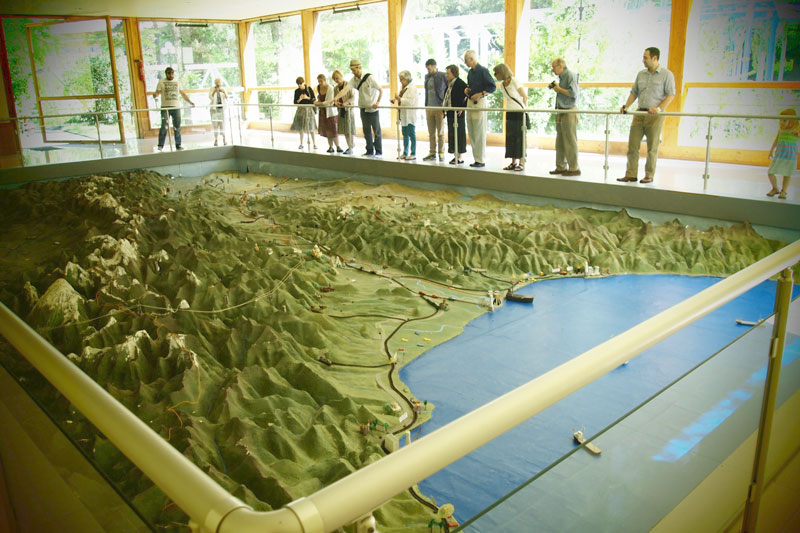 Janine K. (UK) - Colchis & Svaneti cultural tour
Here is a story that I wrote to a friend on our return from Georgia:
Georgia was really exceptionally absorbing. We were with a small group touring just a few of the very old monastery churches, covered in frescoes reaching back to 6th century, our guides (one American and one Georgian) being passionate about orthodox monastic chant, which is indeed very beautiful. One travels in the traces of a long, vigorous and violent history in that old, old country, whose legends include the Argonauts and the Golden Fleece, colourful early Christian saints, and valiant struggles against Greeks, Romans, Arabs, Persians, Mongols and Turks, not to mention more modern times. The high Caucasus snow-covered peaks are tremendous, the wooded river gorges, the grassy plains and the profusion of wild flowers of every hue, just everywhere, were incredibly beautiful. We were starting to cope with the strange alphabet just as it was time to leave! And there is much to discover in Tbilisi, where old and crumbling dignity is mixed with the brash and modern, the tangle of dangling electric wires over dark narrow streets, against very good floodlighting of the fortress, cathedrals and dramatic rocks cradling the river. And every particularly ugly building is blamed on the Soviets and part of the reaction against that drabness is to introduce colour everywhere. Also all the churches, themselves full of colour, are always open with people evidently very engaged in the revival of spiritual and religious freedom. History and traditions have huge importance for all the Georgians we met. We found out about the tour because my husband Bernard met John at a conference in India in February, and had a good impression.
How did you find the organization of the tour?
The choice of Daniel as minibus driver was excellent for his patience, humour, stamina as well as the quality of his driving. His quiet respect and devotion for the monastery churches was an example and his enjoyment of shared meals added to ours. The variety of places chosen for visits, north, south, east and west with Tbilisi as an anchor, offered an excellent overview of the topographical variety in Georgia. The beauty and special features of the monastery churches were well explained by our guides and I appreciated the opportunities to bring the spaces to life with live chanting! The choice of the Hotel VIP in Tbilisi could not have been better, for its simplicity, friendliness, price and location. The three family homestays were all very enjoyable and gave an insight into ordinary family life, which is so important in getting to know a country.
What did you think of the guides? What could be improved?
Both John and Luarsab communicated their enthusiasm and love of Georgia and its people and traditions, including induction into the supra table tradition. Their knowledge of the historical background have inspired me to read more about it and to anchor some of the history in the memory of places we visited. Convenience and lunch stops were well chosen. A less relaxed approach to the schedule, particularly for breakfast and leaving for the day, might result in less options being dropped; on the other hand, flexibility allowed us to spend some time at unscheduled stops, such as the panorama and the poets valley on the way into the mountains of Qazbegi. Both John and Luarsab were excellently informed on the history and the frescoes of the churches and complemented each other in this, but there was not much time to enter into the liturgies where these were offered, or explanation of what was going on, either at the time or afterwards. A resumé of the Georgian Orthodox liturgies could be useful as well as an indication of the meaning of people’s devotional behaviour, such as the meaning of icons for them.
The obvious bonds of friendship, respect and shared interests between John and Luarsab and their relaxed good humour helped to put all members of the group at ease with one another. The compass of the tour was well planned to give as extensive and representative as possible an experience of various regions and places, in the time available.
What was your favorite visited location or experience on the tour?
As difficult to choose as a favourite composer! However, Kasbegi has the edge because of the feel of remoteness and the wild grandeur of the mountains. I loved the hike to the Gergeti Sameba monastery there, particularly as it was there on the ridge line whenever we looked out from the guesthouse. The sense of the valley and the rugged gorge rising from the border with the Russian territories was most impressive. Although not unique in the locations on this tour, the profusion of flowers on the slopes around the monastery and the thought of its isolation in winter, were exhilarating.
In what words would you recommend, or not recommend, this tour to future participants?
I would recommend it as an excellent introduction to Georgia, for those with an interest in the monastic and musical heritage of the country, and in the opportunities to share in some of the best loved traditions of the people, guided by enthusiastic but sensitive experts. The additional forays into other areas of interest such as the Stalin museum in Gori, or the wine cellars in Signaghi, broadened the experience.
Bernard K. (UK) - Colchis & Svaneti cultural tour
Kutaisi had everything: faded, down-at-heel elegance and cultural richness followed by the soaring experience of Gelati Monastery’s slowly bustling liturgy below the steady gaze of its icons. And if that was all too grand, there was the secret jewel of Motsameta Monastery. It was a perfect setting for a homecoming to the garden of clucking chickens (and their droppings) under the vine pergola, eggs laid under bushes, confident cats and overhanging cherry branches with the basilica skyline glimpsed through the washing on the line. Then the western sunlight streaming onto the al fresco cornucopia of a groaning table, livened with witty exchanges over homemade wine in quart jugs. The homestay’s family came and went. It could be Mother taking a corner seat on a spare wooden box, joining in. Or the bright eyes of teenage girls who had left the computer screen for a few minutes to practice their English and then join us late in the moonlight on a noisy walk up the hill to the shrine, chanting hymns and silly songs, until we longed for our pillows. In the morning we found out there had been an overnight drama because of Grandma’s allergy to a bee sting. But there she was endlessly serving breakfast cheesecake to us, big and beaming as if she had just heard that the Russians were going away forever.
Andy P. (Minnesota, USA)
The tour was very well organized, from nice places to stay to making sure we had decent toilets to use during the day. My wife and I enjoyed every minute of it. John and Luarsab really thought of the little things and made the trip as comfortable as possible. John and Luarsab's overall knowledge of what they are doing makes this trip so memorable. Getting to these places on your own would be hard enough, but to travel there with two people that have such intimate knowledge of monasteries and overall Georgian history really makes this a trip to remember. The entire tour was just fabulous. We hope to do another part of it again another year, as some of the locations change. This tour is a wonderful way to intimately see Georgia! Does not matter what prior knowledge or experience you have had, there is no experience like this. Hearing the chants in the church are simply amazing, and it is just a wonderful experience!
Vivien S. (New York, USA)
I would absolutely recommend this trip, especially to seasoned travelers. I'd recommend it because you guys are really fun to travel with; because Georgia is scenically stunning; it's off the beaten track and (so far) un-touristy; friendly people; the music is wonderful; the food delicious; and the churches / monasteries / history are very interesting.
2009:
- by Rebecca S. (Asst. Professor of Russian Literature, Columbia University, USA)
I have so many wonderful memories from the 2009 Monastery Tour that it’s hard to pick out just a few to write about. I had dreamed of visiting Georgia ever since 1995, when I first heard Georgian singing (at a concert in downtown Manhattan) and, on a subsequent trip to Moscow, tried Georgian food for the first time. Funnily enough, one of the most magical moments on the tour arrived in the form of one of those predictable Georgian power outages (apparently they aren't as common as when I lived in Moscow), a moment usually hailed by the Georgians as a serendipitous opportunity for romance. On our second night in the picturesque town of Telavi, a blown fuse in the host’s dining-room prompted us to move our home-cooked Georgian feast outside, under the grapevines. A pair of guests arrived, friends of John and Luarsab from the choir of Alaverdi Cathedral, and (with John and Luarsab supplying the bass drone) they sang endless Khakhetian songs to us as the sunset faded into twilight. Candles were lit, and between songs we drank toasts with our host’s homemade wine, which he brought out specially to share with us. It was that moment – sitting among new-made friends, drinking delicious Georgian wine under the very vines from which it was harvested, listening to the gorgeously intertwined voices of Kakhetian harmony as the stars twinkled overhead – that I thought “Now I’m really in Georgia.” We met with warm welcomes and great kindness everywhere we went in Georgia, but I particularly remember an afternoon when four of us were wandering through Telavi and stopped in front of a bread bakery, or to-ne. We were marveling at the font on the sign – which made the Georgian letters almost unrecognizable to those of us just learning them! – when the baker himself popped his head out of the window and called out “Hello!” with a big grin. “Hello!” we chorused back.
He beckoned Jay over and handed him a loaf of flat bread. “A present! For you!” We were all far too well-fed to be hungry, but Jay manfully tore off a piece of bread and ate it, assuring the baker in Georgian that it was “very delicious,” dzalian gemrielia (this was an expression we learned quickly, as it applies to almost everything in Georgia). “Come!” said the baker, delighted with our newly-formed friendship, and beckoned us around the back of his store, where he gave us a tour of the bakery (one large bread-kiln, fed by an underground furnace) and -- in a mixture of Georgian, English, Russian, and gestures -- explained all about the baking process. With his encouragement, we took pictures and video, and asked lots of questions. “Come back tomorrow morning to watch us bake! Bring your friends!” (Not all of us were wakeful enough at 6:30am to take him up on this invitation, but some did.) As we left, he loaded us up with more gifts of bread, which we ate that night with our hostess’s gemrieli home-cooked dinner under the grapevines. After hiking in the desert to see the amazing cave frescoes of Davit Gareji, travelling to the high Caucasus made quite a change! For one thing, we exchanged blazing sunshine and temperatures in the high 80s for coolness, mist, and long-sleeved sweaters. For another, the elusive but unforgettable sight of Mt. Qazbegi awaited us. Wreathed in cloud for much of the day, this majestic peak revealed itself at sunrise (also an excellent time for walking through the village and watching its early-rising residents lead their cattle off to their daytime pastures), and could be seen right from the windows of our homestay!
Climbing Mount Qazbegi was, of course, not on the program John and Luarsab had planned for us (a four day high alpine adventure), but they did lead us to the summit of a more accessible mountain -- one of Qazbegi’s foothills – where the Gergeti-Holy Trinity monastery is perched at a height of 2200 meters, surrounded by breathtaking views. Being in this landscape felt like being dropped into the setting of “The Sound of Music,” with the added bonus that of course we had many singers in the group and indeed, at each rest stop on the way up the mountain, part-songs made their appearance. At the summit, Luarsab made the joyful discovery that the wind blowing across the neck of his water bottle made a low note that could serve as a drone, and began singing “Orovela” over the top of it. Would he have been so sanguine if he had known that that very night, his invincible reputation at backgammon would be shattered by the upstart rookie Jeremy Wood? We will never know. ***
 Robert D. (Prof. Emeritus, U.Chicago)
An Epic on the Georgian Chant Journey
in the style of Shota Rustaveli
Composed in Kazbegi at 7:00 A.M. on July 4, 2009
I am the ancient bard of SaKartvelo,
By name and fame I pass as SaRoberto.
I sing of the Georgian heroes of old:
King Joni the Great, whose story is told
In legend and chant throughout Iberia.
He came from the faraway land of America
And conquered the Georgians with song and with charm.
I sing of Luarsab, Joni’s right arm,
The noble tamada par excellence
Who guided them all, leaving nothing to chance.
And I sing of Queen Maka, who hails from Svaneti:
Wise and courageous, witty and pretty,
Nothing about her was petty or prissy.
John, Luarsab and Maka ruled from Tbilisi.
This threesome was awesome. They led a band
Of nine chanting warriors through't the land,
Piloted by the noble Gia,
Their Argo was a white mashrutka.
First to Kakheti, that fruitful plain,
Where they drank and they drank, and drank again.
Their only warcry was Gaumarjos!
They followed the footsteps of St. Nino’s.
Signagi and Telavi fell under their spell.
In Kazbegi too they fared quite well.
Who were their friends, the inseparable nine,
Who shared their woes and their joys and their wine?
Tami the great, who hailed from Chicago
And held the key to the Georgian farrago,
That inscrutable tongue, whose consonant clusters
Are so many tongue-twisters and gum-busters.
With the help of her faithful husband Jay
She unlocked Georgia’s secrets and ruled the day.
Rebecca too and her sidekick Chris,
Who came from New York spreading wisdom and bliss.
Ian of Sidney, who followed the traces
Of Georgia’s saints to faraway places.
Nebojsa, that architectonic savant,
Who photographed every inch of the land.
Jeremy, with experience gained far and wide,
Regaled them with stories and kept them in stride.
And with Gemütlichkeit, kindness and truth,
From Colorado, the indomitable Ruth.
The ninth was this ancient bard, known as Bob-a
Whose final word is: Didi madloba!
Ian H. (Melbourne, Australia)
Life-Changing Experience at Davit Gareji
I have always been drawn to Syriac Saints -- their writings, whether prose or poetry, offer a unique perspective on Biblical texts and Salvation History that has always spoken deeply to me. The lives and sayings of the Desert Fathers also hold great affection in my heart, as does monasticism in general. The idea of withdrawing from the world to hard and inaccessible places to do battle with oneself and one’s passions, whether as a stylite in a cave or dwelling, or one living in community within a monastery.
Davit Gareji: a complex founded by Syriacs [St Davit, one of the 13 Syrian Fathers who traveled to Georgia in the 6th century, and his disciples Ss Dodo and Lukiane], a ‘desert’ environment, and a monastic life in cells on the rocky face of a mountain. The stage was set for this to be a humbling and moving experience for me: and it was -- far more than I could have expected. It was wonderful to see that the main monastery of the complex, the Lavra, is active today. The tombs of Ss Davit, Dodo, and Lukiane are in the Church of the Transfiguration, and it was a blessing and privilege to pray at their tombs, asking for their prayers. Although separated by time, and death, we are one and in communion through Christ.
Udabno: After our visit at the Lavra, it was up the mountain, via a steep hike, to the Udabno Monastery Cave Complex. During the 9th to 13th centuries, this complex was home to one of Georgia’s most important schools of painting and, thanks be to God, frescoed masterpieces from those times can still be seen inside the caves. From the sheer number of cells, whether plain or ornate, to the refectory with its stunning icons including one of the Last Supper, all cut into the rock, each moment was a blessing. Even the simple act of walking the path along the side of the mountain, and looking across the barren landscape towards Azerbaijan, had me pondering on, and praying for [I can think of no better response to the sight of this monastery] all those who had made this their home in times past.
In one sense, the Udabno Monastery Cave Complex had a feeling of a ‘museum’ as the caves are currently not populated. Active monasteries or convents are always special in that the tradition of monasticism is continuing and alive: a living and active faith. That said, in a greater sense Udabno was most definitely an inspiring experience: to stand where Saints had stood; to walk where they had walked; to see a cave complex monastery for the first time in my life — all spiritually challenging and blessed experiences. It is my prayer that places such as these may once again, as I saw constantly in Georgia, flourish as active monastic centres. Or, if these cannot, that, again as I saw in many places in Georgia, new monasteries will be built as people embrace the monastic life. In Eastern Orthodox thought, the state of the Church is often seen as reflected in the state of the monasteries — healthy, active and spiritual monasteries lead, through their very presence and the prayers and spiritual guidance of the monks/nun within, to a healthy, active and spiritual Church.
Pondering my feelings and thoughts at Davit Gareji at a distance in time and space [a month later from Australia], and also considering the many conversations I have had since my visit there with various people, a longtime dream has returned to me. And I have made the decision to keep this dream, alive, and to take steps, however small at first, to work towards it. What is the dream? — visiting Balamand Monastery and considering some theological study at the University of Balamand in Lebanon. By this I mean no slight on Georgia, for I would love to return there, and particularly return to stay at several of the monasteries we visited [Davit Gareji Lavra being foremost on that list]. But, for reasons unknown, I feel a pull towards the Middle East, and Lebanon in particular. And the thought of going for a year, just to see how I do, does not seem so foolish now; it doesn’t seem unreachable, or like something I should not do — the “calling,” for want of a better word, seems stronger and stronger. And I truly believe that the half-day spent at Davit Gareji, and the emotions, feelings and inspiration raised within me there, began the process that led to this. Thanks and praise be to God. Through the prayers of our Holy Father St Davit of Gareji and the other 12 Syrian Fathers, may the Lord have mercy on us and save us.
2008:
Leslie T. (Westminster, VT)
August 2008
"Dear John, Luarsab and Nino, Malkhaz and all our friends in Anchiskhati and Zedashe, A few weeks back John wrote and asked if I would write something about my experiences on the monastery tour. I had been thinking about Georgia so much since we were there and didn't know quite how to distill my thoughts and feelings into a few sentences.
How does one describe the warmth of the relationships or the arresting and elusive beauty of Mt. Qazbegi? I’ve been thinking about the guard we met at the Russian border who seemed so relaxed and, in retrospect, so distant from any thoughts of war. I think I would have written about how at peace and how hopeful I felt in Georgia. I would have written too about how resilient and rugged it seemed and about the flowers that seemed to grow and flourish on the sides of mountains in places where I least expected them. It has been so hard to reconcile those images and emotions with those conjured by the chaotic news reports that have come our way this past week. We feel so far away and so powerless to offer anything tangible that can possibly represent our deep care and love that we feel for all of you. We are praying for your resilience and for your capacity to create beauty in hard times.
We were so grateful that Malkhaz was here with us this past week. I think we poured our love of Georgia into every interaction with him and each hug felt like we were all reaching out to touch Georgia and envelop it and all of you from afar. I don't think I will ever forget Malkhaz. In the midst of everything that was lost, I can say that I gained one true friend. That friendship is as special, unexpected and sweet as those mountain flowers that grew on the mountain-sides in Qazbegi. After four days I said to Malkhaz that I felt as though I had known him forever. He said, "I feel like this war has lasted forever." And I felt that way too.
I thought a lot about the Anchiskhati Choir on tour (in Sweden during the August invasion) and Luarsab and Nino on vacation and about how hard it must have been for all of you to be away from home. It was such torture for Malkhaz to be away from his family and we worried about all of you who were also separated from your families and swimming in the same chaotic and conflicting news reports that we were. At one point I feared the phone lines would go down and Malkhaz would be cut off completely. I am so happy that he is home safely and I hope that Luarsab you and Nino and Anchiskhati are also back in the arms of those you love.
Take care, Leslie
Vrinda C. (Princeton, NJ)
I came to Georgia on the Monastery Tour last year with several goals in mind. I was interested in Georgia’s tradition of polyphonic music, its art, culture and history, and its language, and it was my hope to gain a better understanding of all of these. With no overstatement, I can say that the tour exceeded all my hopes and expectations in helping me to achieve these goals. In touring the monasteries, I learned about the rich culture, both sacred and secular, of Georgia. We visited 6th century churches and saw the worn frescoes decorating their ancient walls. The guides at each monastery offered detailed accounts of the history of the churches and expertly described the icons and architecture. We heard about the pre-Christian traditions and the early Christianization of Georgia. We also heard many stories about the devastation wrought during the Communist period and about the current revival of the old culture, in which Luarsab Togonidze, one of the tour leaders, is deeply involved. In various churches, we were able to listen to the unique polyphonic chant which varies in style from region to region and even had the opportunity, thanks to our guides, to learn several of these unique and beautiful songs ourselves.
At Princeton, where I am a graduate student in Slavic and Theoretical Linguistics, I am part of a choir that performs Georgian music, and last summer on the tour, I was able to hear for the first time how these songs are meant to be sung and how powerful they can be in their original context. We learned the history of the music, much of which predates Christianity in the Caucasus, as well as some of the more technical aspects of the music, as John Graham, one of the leaders of the tour, is a doctoral candidate in Musicology.
My linguistic interest in Georgia was also addressed during the tour. I had studied some Georgian prior to the tour and was baffled by the seemingly endless complexity of the Kartvelian languages. In Linguistics, it is not uncommon for a theory to be valid for virtually every human language with Georgian being the radical exception. So, I took it upon myself to study the syntax and morphology of Georgian to discover that it has one of the most highly complex verbal systems of any natural language. While on the tour, I did not study Georgian systematically (I continued to study Georgian in Tbilisi after the tour ended), but gleaned some passive knowledge of the modern spoken language, being constantly exposed to it. John and Luarsab were both ready and able to address many of my questions concerning the Georgian language and I gained some knowledge of the fundamentals of Georgian syntax, which provided me with a basis for further inquiry. And what I came to understand during the course of the tour is that the language underwent a series of transformations during various invasions and occupations and that its lexicon is now filled with borrowings from Persian and other Indo-European languages.
The Monastery Tour not only provides glimpses of an ancient culture and language that are profoundly distinct from all its neighboring cultures and languages, but it also appeals to the academically minded. If your interest is in history, music, art, architecture, religion, or linguistics, the Monastery Tour in Georgia can provide an insightful introduction to these subjects that will surely inform your continuing studies.
Valeria C. (King's Lynn, UK)
Dear Friends,
I'm home safely only to be plunged into raspberry jam-making and weed eradication, hence a later reply than I would have wished. I have to say that because of the country's infrastructure, I realize that the plumbing may not always work. It would, however, be helpful to have a spare chair in the room for one's clothes/case. Also a hook for hanging the coat.
CHOICE OF RESTAURANTS - Excellent
Also TRANSPORTATION Excellent.
I loved the fact that the Nekresi Monastery stop was spontaneously included on Monday 30th June. To reach what seemed like a deserted monastery after negotiating a steep track up the hillside and there to find a fully robed priest and his deacon taking Divine Liturgy with a congregation of two novices was for me the highlight of an infinitely memorable trip. Likewise, to experience the haunting Aghdgomasa shensa chanted by the group in the St. John the Baptist cave church at Davit Garegi. It lives with me.
My only criticism was that 'start time' should be a definite departure time - not 'Georgian time' which is very hard for us Westerners to work out! Thank you all and Nino for a unique trip in a unique country - and since my return I have enjoyed re-listening to the CD! Many thanks, Yours, Valeria
2007:
Terry C. (Tyler, TX)
On the topic of the SUPRA (traditional feast)
The supra is the quintessential Georgian experience. The tradition involves much more than a simple feast. Certainly the tables are laden with food, and the wine flows, but this is merely the venue for what is actually an elaborate and ritualized ceremony.
First of all a tamada (toastmaster) is appointed. He or she is usually the host of the event or is elected from among those at the gathering to preside over the formal structure of the supra feast. Especially, the tamada is in charge of establishing the order and subject of the toasts. And only he can change the topic. He can appoint an alaverdi, whose exact responsibilities are still unclear to me. The toasts can be quite lengthy, and as the wine flows, so does the oratory.
Wine occupies a special place in Georgian culture. Their beer is excellent, and vodka remains popular. The homemade cha-cha is brought out before bedtime, or at breakfast, for a morning pick-me-up. But Georgians are, first and foremost, wine lovers. They claim to have invented wine itself. I won’t argue the point with them, but without doubt, they produce some of the very best wine in the world. To the Georgian, wine is seen in a spiritual context—a manifestation of God’s blessings upon them, and also a means of praising Him. All supras begin with a toast to God. There’s a line I like from one of the songs sung by the Zedashe Ensemble; “fill our laps with bread, fill our cellars with wine, Glory, God is glorified!”
Most Georgians produce their own personal wine. No garden is complete without grapevines. Traditionally, wine is stored in huge clay jars buried in the ground, up to their rim. Families would devote one jar for their special wine, which they would only drink when toasting their ancestors. This reserved jar was known as the zedashe.
Our first supra was on a balcony overlooking the valley, with the Caucusus Mountains beyond. The hillsides below Sighnaghi were forested, all the way down to the valley. We could see 3 clearings, however, each containing a small church. Luarsab explained that there were once villages scattered up and down the hillside. The Communists made the residents abandon their homes, move down to the valley, and establish new towns along the railroad. The forest reclaimed the towns, save for the churches, which the villagers stubbornly preserve and return to from time to time. But there is more. Families carefully marked their zedashes. And so they still return to their old home sites, and toast their ancestors as before.
The role of wine in all stages of Georgian life was brought home to me while we were at this first supra. A group of young men were gathered at an adjoining table, joined by 3 musicians. From my American perspective, it first looked like a boisterous drinking party. The bowls of wine were kept filled, toasts were being made, and one of the men broke into a traditional Georgian dance. Another was looking out across the valley, and I could tell he was close to tears. Only later did I realize the pathos of this scene. For this was a wake for a young friend who had recently died.
But back to the supra....Wine is traditionally drank out of clay bowls. You are not to fill you own bowl, nor or you to allow your neighbor’s to go dry. When you are drinking, you should grasp the bowl in a firm, manly manner, with elbow at the same level as the bowl or glass. If you are using glasses, and doing the traditional clinking of glasses together, to touch your neighbor’s glass well below the rim is to show respect to them. There is even a method of pouring the wine from the pitcher. No one is to drink while the toast is being made. When the toast is finished, everyone says “Gaumarjos!” (meaning “Victory”) and drinks up.
Our most unforgettable supra had to be the one in John's house in Sighnaghi. The event lasted 3 hours or so—nothing special for Georgians, but a long time at the table for we wimpy Americans. John had tables pushed together into a t-shape in the large back room of his wine cellar. The food, as was typical, was served in courses. And it just kept coming. Early in the dinner, the Bishop and six or eight guests showed up and joined us. This too, is typical. People just show up. We moved in closer together and made room for them at the head of the table.
The Bishop of Alaverdi was a most gracious man. He was either an architect or engineer by profession before taking vows. He spent 10 years at the Lavra Monastery at Davit Gareji. The Zedashe Ensemble members were also in attendance, so the toasts were broken up by singing and music. (For more information on this talented group, their 2007 East Coast tour, and how to order CDs, go here.) Later on, there was traditional Georgian circle dancing. Most of the toasts were quite special, although some of our tour group’s toasts towards the shank of the evening were, shall we say, overly lubricated. I particularly remember the toast made by Shergil. He is a Svanetian, living in Sighnaghi and singing with the Zedashe Ensemble. He is also a most talented woodcarver, a small wooden box he carved now among my treasures at home. Anyway, he simply said “Remember your ancestors, and the place of your ancestors. For they will keep you warm.” No more Georgian a sentiment could be made—and it is one that resonated with me.
At long last, we stumbled to our homes in the dark—full and contented, a little bleary-eyed, and feeling altogether blessed.
Terry C. (Tyler, TX)
On Singing
John and Luarsab set out to teach us just a bit of Georgian chant. They chose “O Holy God” (Holy God, Holy Mighty, Holy Immortal, Have Mercy on Us) The words, roughly transliterated:
tsmin-da-o ghmer-to,
tsmin-da-o dzli-e-ro,
tsmin-da-o uk-vda-o,
she-gvi-tsqa-len chven.
We chanted this hymn in at least 8 of the churches we visited. The acoustics were absolutely incredible. These old Georgian churches—with their concave ceilings, and height, width and length in just the right proportions—indicate to me that the architects of old knew a thing or two that the modern world has forgotten. To chant this, in these old churches, never failed to send chills down my spine. The above title came from a toast given by Jay, one of our tour group members. His description is apt.
Beauty—whether in nature, architecture or people—is always close at hand in Georgia, ready to be discovered anew. Jay is a Lutheran pastor who lives in Manhattan. He is also a displaced Texan. This bizarre combination makes him—if nothing else—eminently quotable. He also said: “Georgia is a tiny country where everything is famous, fabulous, extreme...As such it is an icon of the grace of God; abundant, inexhaustible—a feast where all are welcome, where nothing which is given is ever taken away...” I like that. I also like the following quote from Nikos Kazantzakis, a Greek writer who fell in love with Tbilisi and Georgia: “Handsome Georgians are careless, they’re fond of wine, war, women and freedom.” And this quote from St. Ilia Chavchavadze (d. 1907): “Christ our God was crucified for the sake of the world, and we likewise have been crucified for His sake. We bared our breasts for this small Georgia, and on our breasts, as on a rock, we erected a temple to the Christian God. Instead of stone we offered our bones, and instead of lime we offered our blood, and the gates of hell will not prevail against it!”
Terry C. (Tyler, TX)
On Vespers
We spent the last two days of our tour, Saturday and Sunday, in Tbilisi. Saturday morning was open—with some of us going to the Botanical Garden and others visiting with Dato the carpet-man. Later, Luarsab led a group of us to the vast Farmer’s Market. Some were looking for spices, and others (me) were looking for wine to carry home. Everyone was to meet late in the afternoon at the 6th-century Anchiskhati Church, Tbililsi’s oldest, where we would attend Vespers. Luarsab assured us that we would hear some of the most beautiful chanting at the Vespers Service here. Vespers had been pushed back a bit later, we discovered. But there was plenty going on in the church. On the right side of the nave, an infant’s baptism was taking place. On the left side, a family was bringing in food for a memorial service for a departed loved one. There before us was the complete circle of life—from birth to death—within Orthodoxy. We decided to visit another church nearby and see if their Vespers had begun. Finding an Orthodox church in old Tbilisi is about as hard as finding a Baptist Church in East Texas. Sioni Cathedral was 2 blocks away, perhaps, from which Jvris-Mama Church was one block away. Metekhi Church was just across the river. Two churches were being restored between Sioni and Metekhi. That is not even taking into consideration the Armenian churches. You get the picture.
Sioni was the cathedral church of Tbilisi until the recent completion of the Sameba Cathedral in 2004, but it is still the seat of the Georgian Orthodox Church. The Patriarch Ilia II, lives in the adjoining Patriarchal residence. Vespers had not begun at Sioni either, though there was already a sizable crowd. Several of us lit candles and venerated the icons. A woman approached me, raising money for the restoration of a 6th-century monastery in the countryside. I gave her a contribution. A little later on, she came back to me, and asked me my name. I told her and her eyes lit up. “I knew it,” she said. She handed me a small laminated card, with a picture of the monastery on one side, and an icon of St. John the Forerunner on the other. She had a sense that my name was John and she wanted me to have the icon of St. John. She thanked me again, and told me to keep the icon with me always. I have tried to do so. We then walked over to Jvris-Mama Church, where Vespers were underway. The church was more or less packed, mostly with younger people. The crowd were a little noisier than what we are used to, but this seemed to be quite normal for this church. John G. led us to the grotto within the compound, and showed us where he had been baptized a few years back. After a bit, we hiked back over to Anchiskhati Church, where Vespers were finally underway. We edged our way into the crowd, as the nave was fully packed. Interestingly, the men were on the right and the women were on the left. There was no noisiness as in Jvris-Mama. Everyone was quietly and reverently attentive.
Visiting the three churches gave us a good perspective on Georgian Orthodox worship. What really impressed me was the fact that all of these churches were packed full. And this was for Saturday Vespers. But this in no way prepared us for the experience of Divine Liturgy at Sameba Cathedral the next morning. The recently completely Sameba Cathedral is the third largest Orthodox Church in the world, ranking after churches in Moscow and Belgrade. It dominates the Tbilisi skyline. Sadly, like Orthodox everywhere, we arrived a little late for Liturgy Sunday morning. I noticed a large crowd milling around the plaza surrounding the cathedral. As I got closer, I realized that most were outside because they could not get in. I spent the next 30 minutes or so slowly inching my way into the center of the church. The immense cathedral was packed to the brim. They had even opened the balcony. I suppose there were at least 2,000 people inside, and probably much closer to 3,000. About 500 or so were outside, filtering in as others went outside for air. I have never seen anything quite like it. But that was not all. The crowd was overwhelmingly young. I felt like an old man. I would estimate that 80% were 30 or under. Probably 70% were 25 or under. Luarsab later explained that the nationwide test for college entrance was the next day. Many of these young people were in Tbilisi for that reason and came to the church service to pray. In my view, that in no way discounts what I observed. Their presence there was a testimony to the enduring faith of the Georgian people, now taken up by the country’s youth.
Michael S. (Delaware, USA)
This summer, I was privileged to travel to the Republic of Georgia with my wife on a nearly three-week tour of that country's many amazing sites: its monasteries and churches, wineries, historic cities, and, most of all, its warm, welcoming people. Never have I been in a country that felt more connected to its roots, where the past and present walk together hand in hand, the future beckoning in the distance. Beyond Tbilisi, which is striving mightily to become a European-style capital--as well as the cell phones which every Georgian seems to favor over the antiquated telephone system--modernity is hard to find in Georgia. Farmers ride haywains behind horses down pockmarked roads, battling for supremacy with ancient Fiats, Ladas, second and third hand delivery trucks late of German and French companies. Wine is still made in places the old way, by picking grapes and stomping them. 1,400-year-old churches resound with ancient liturgical chant. Men and women make crafts by hand, with loom, and knife favored over factory.
Georgia has suffered immensely over the centuries. Constantly beset by invaders from the south, east, and west; speaking a language unlike any other tongue in the world; singing songs with unique melodies and tunes; Georgians developed an insular, self-reliant mind-set. Fortified monasteries were built all over the country, places of refuge to which towns and villages could flee in times of attack. One such town even turned itself into a huge fortress in its own right--Sighnaghi. It is perched high on a hillside near the Azerbaijani border in the Kakheti region in the shadow of the Great Caucasus Mountains; its steep streets ringed by a huge network of walls studded by twenty-four towers, one assigned to each of the villages in the region, where food and weapons were stored for use when the region came under siege and the villagers had to flee to that place of refuge. Read the rest of the article here.
2006:
Alexandra L. (NY, USA)
My trip to Georgia was a remarkable experience. Of all the beautiful sites and experiences we enjoyed, the most spectacular was an overnight trip to the town of Kazbegi. The stark beauty of the countryside and the amazing mountain vista were visible as we drove to the town. Nothing, however, compared with the walk to the monastery, the awesome spirituality of the monks, or the overwhelming beauty that we encountered the next day in the Dariel Gorge. I have visited many places in my life, but these two days stand out for me as two of the most beautiful and moving days of all my travels. I have never encountered spirituality as palpably as I did in this isolated monastery with these humble monks as dusk gathered around the mountain on which we stood. And of the wildernesses I have visited, from the Grand Canyon and Yosemite to the deserts of Cappadocia, never have I been so struck by the power of nature and its ability to create a place so remarkable that I have found no way to describe nor seen any picture that can capture its beauty, its ferociousness, or its awe-inspiring heights. Georgia has many things to offer - beauty, music, food and wine - but the most spectacular and unique of all its gifts lies in the peaks and valleys of the Caucasus.
David L. (NY, USA)
Visiting the Republic of Georgia is an experience that one remembers forever, not only because it is half-way around the world and one of the most unique countries in the world, but because the place tantalizes each of your senses in turn. It’s really all about the people. Georgians will capture your heart. The expression “Guests are sent by God” permeates all aspects of life in Georgia, and from the moment of arrival, Georgians seem to do everything within their power to reassure their guests that they take the expression seriously. In spite of their history being a constant struggle to survive, having been overrun by the Persians, Turks, Russians, Soviets, and countless other neighbors throughout the ages, Georgians have maintained their independence and uniqueness. In fact, they treasure and celebrate their culture almost to a fault. Westerners who visit Georgia are often taken aback by the near arrogance of Georgians when they speak of nation and heritage. However, one has to remember that these people have survived a long and difficult history and now sit on the cusp of the future, where for once they will shape their own destiny, without interference from neighbors or enemies.
The future looks bright for this small nation nestled inside the Caucasus mountains between Turkey, Russia, Azerbaijan, and Armenia. Set free from the control of the Soviets over a decade ago, Georgia now looks to set a course that will introduce Europe and America to this country, its heritage, and resources. Tbilisi, the modern capital, is the closest place one can find that is reminiscent of western civilization. With its tree-lined boulevards, winding narrow back streets, and assorted styles of architecture, Tbilisi blends the old with the new seamlessly. Indicative of a trend to restore Georgian heritage, new structures in the capital compliment the historic architectural gems throughout Tbilisi’s famous neighborhoods. A mid-summer stroll along the Mtkvari river in Old Town Tbilisi is a glorious experience, especially seeing the numerous churches and monuments of the city lit in the amber hews of Tbilisi’s ample night-lighting. At night, the Narikala Fortress, Metekhi Church, and the newly completed Holy Trinity Cathedral radiate the warmth and hospitality of Georgia against the black velvet sky.
The rebirth of the Georgian Orthodox Church has resulted in the restoration or construction of hundreds of churches throughout the country. While the ratio of churches to people has left the Church at a disadvantage to meet the spiritual needs of the people (every church is overflowing), it has made an impact on the younger generations in Georgian society. The Patriarch of Georgia, Ilia II, is a kind and warm man. Seen as the nurturing, good pastor to the people in his native land, the Patriarch has made a concerted effort to inspire the young people of Georgia to adopt a work ethic and spiritual manner of living that will honor their ancestors and provide for their children’s generation. This approach often contrasts with strong educational values during the Communist era when people learned to get by doing little more than the minimum, eventually leading to a nation-wide epidemic of nearly 85% unemployment. Slowly, the positive results of the Patriarch’s efforts have become visible throughout the country. While their parents sit idle at home or along village roads playing chess and backgammon, young people can be found studying at university, attending church, and striving to make their lives better. Tbilisi boasts the largest advances anywhere in the country for public works, and western marvels like a ATMs, McDonald’s, Baskin Robbins, and the latest movies from Hollywood. In the local villages of Eastern and Western Georgia, modernization has not been so quick, and life remains simple.
Susan M-C (Burlington, VT)
Newly scythed grasses, strewn about the base of massive gray pillars on the terracotta pave-stone floor, breathed an herbaceous scent into the festive air. Icons, angled to the heavens on wooden pedestals (the better to be kissed), were decorated with woven flower garlands. The smells of the field mixed with the spicy aroma of church incense, and the softer honeyed tone of beeswax tapers, guttering away in candle stands, combined to produce a bewitching sensory overload. The liturgical color green, for the birth of the Church through the power of the Holy Spirit, adorns churches throughout Georgia today; it is the feast of Pentecost! Eastern Orthodoxy, for those not familiar with it, has several hundred million adherents worldwide, concentrated in Russia, Greece, and most of the countries comprising the former USSR, as well as northern Africa, and the United States. Orthodoxy is distinctly different from Anglicanism and other Protestant religions, yet also familiar. One writer, Robert Kaplan, author of Eastward to Tartary, calls it the “ancient, fierce, Asiatic face of Christianity.”
Inside the ‘Alaverdi’ Cathedral, an enormous stone cathedral nearly 1000 years old, the men stand on the right and the women, bright colored cloths on their heads, stand to the left. Greens are all over the floor. Ten men dressed in ordinary street dress are gathered around a podium in the south transept, chanting in impeccably tuned, but to Western ears oddly dissonant, harmony. Several hundred people stand quietly praying, (Orthodox worshippers stand; there are no pews), or walk around the church speaking quietly to each other. Finally, the Bishop's knock sounds on the heavy wooden doors; he is met by his awaiting clergy, escorted to his cathedra, and assisted into the liturgical vestments of his office. The Bishop, ‘Meope Davit’ to all who know him, is also a monk, and notably wears his episcopal vestments only during services, arriving and departing dressed as a simple monk (per Orthodox tradition). The investiture took a leisurely ten minutes, a prelude to the more than 3 hour-long service. The Divine Liturgy in the Orthodox rite is the central act of worship, as in our Anglican church, but here one notices that nearly every word of the liturgy, and the scriptural readings, are chanted! Orthodox chant varies enormously between countries, the Greeks having their style, Russians another, and so forth. The traditional chant of Georgia is an ancient, un-tempered, three-part harmony singing from the middle ages which is ferociously difficult to master. In the past year, two Fulbright scholars have undertaken study of this chant, some of whose roots can be traced back a thousand years, with a few provocative remnants pointing to the pre-Christian era.
One of these scholars, 27-year old John Graham, is our tour organizer of Medieval Monasteries of Caucasus Georgia and is now pursuing a doctorate in musicology at Princeton. His Georgian counterpart, Luarsab, is a radiant giant with a high tenor of unearthly brilliance and power, has been our Georgian master of the revels. And revel we have! We have visited twenty churches and monasteries in the past eight days, with long dinners each evening, in traditional Georgian style, frequently with local singers joining us at table for folk-singing. Sometimes there is dancing, and always a few large bowls of deliciously fresh Georgian wine, accompanied by toasts so moving and eloquent as to be genuine agapes. The evening ends as it has in Georgia for perhaps more than a thousand years, with a final toast to the Theotokos: Mary the Bearer of Christ.